The shower has gone weak. Not dramatically, just enough that rinsing shampoo out takes longer than it used to, and when someone flushes a toilet while you are under it the water thins to a trickle. You assume it is the shower. You buy a new shower head. It makes no difference, because the shower was never the problem.
Low water pressure is one of the most common complaints we hear in Tavira homes, and it is also one of the most misdiagnosed, because the fix depends entirely on a question most people never ask: is it one tap, or is it the whole house? Those are two completely different problems with two completely different causes, and telling them apart takes about five minutes and no tools.
Pressure versus flow, and why it matters
A quick distinction that clears up a lot of confusion. Pressure is the force pushing water through the pipes. Flow is how much water actually comes out. You can have decent pressure but poor flow if something is restricting the path, like a scaled-up shower head, and you can have genuinely low pressure across the whole system. They feel similar at the tap but they have different causes, and the tests below are really about working out which one you have and where.
For reference, normal domestic water pressure sits somewhere around 1.5 to 3 bar in the range that Portuguese regulations recommend for comfort and for the durability of your pipes and fittings. You do not need to memorise the number. You need to know whether your problem is everywhere or in one place.
The five minute test that locates the problem
Do this before buying anything or calling anyone. It is the single most useful thing on this page, because it tells you whether you are looking at a cheap fixture fix or a whole-house issue.
- Go to the weak shower. Now turn on the basin tap in the same bathroom.
- If the basin is fine but the shower is weak, the problem is at the shower, its head, its valve, or the pipe feeding it. Stop here and skip to the single-fixture section.
- If the basin is also weak, move to another room. Try the kitchen tap and a second bathroom.
- If several fixtures across the house are weak, the problem is upstream, at the main valve, the pressure reducing valve, or the incoming supply. Skip to the whole-house section.
- As a final check, run the shower and flush a toilet. If the shower collapses while the cistern refills, that confirms the supply is struggling to serve two demands at once, which points upstream.
That is the entire diagnosis. One weak fixture with everything else fine is a local problem and usually cheap. Several weak fixtures is a system problem and needs a different approach. Almost every mistake people make with water pressure comes from skipping this step and treating a whole-house problem as if it were a shower problem.
When it is just one fixture
Good news, because this is the cheaper category and often a genuine do-it-yourself fix. The causes, in the order worth checking:
| Cause | Check | Fix |
|---|---|---|
| Scaled shower head or aerator | Look at the nozzles. Furred, white, jets firing sideways | Unscrew and soak in white vinegar or citric acid overnight |
| Blocked handset filter | Small mesh filter where the hose meets the handset, often full of grit | Remove and rinse |
| Kinked or collapsed hose | Shower hose twisted, or collapsed internally | Straighten or replace the hose |
| Partly closed isolation valve | Small valve on the pipe feeding that fixture, sometimes left half-shut after a repair | Open it fully |
| Failing or scaled mixer cartridge | Weak flow plus stiff or erratic temperature control | Cartridge replacement, sometimes a plumber |
In a hard water area like this, the top of that list does most of the damage. A shower head that has been slowly furring up with scale for two years will lose a surprising amount of flow, and because it happens gradually nobody notices until it is bad. This is the single most common cause of a weak shower in Tavira, and it costs nothing but an overnight soak. If the aerators on your taps are also crusted, that is your confirmation that hard water is the culprit, and it is worth understanding what else the scale is doing, which we covered in our guide to hard water in Tavira.
When it is the whole house
If several fixtures are weak at once, the fixture itself is innocent and the cause is somewhere in the supply. These are the realistic possibilities.
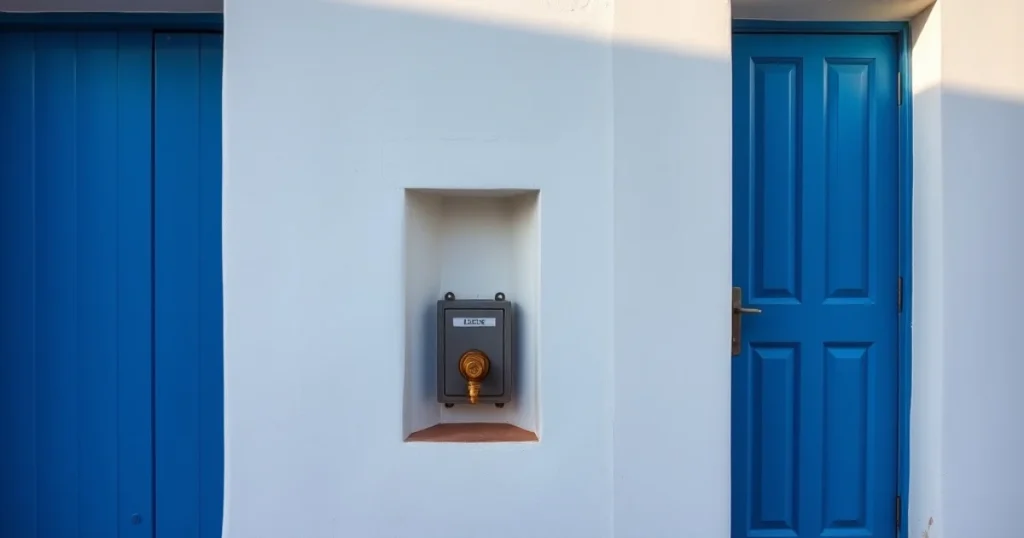
A partly closed valve. The simplest and most overlooked cause of all. The main shut-off where water enters the property, or an isolation valve on the line, can get knocked or left not-quite-open after any repair or maintenance. It throttles the whole house with no other symptom. Before assuming anything worse, find your main valve and confirm it is fully open. This genuinely fixes a meaningful share of whole-house pressure complaints for free.
A failing pressure reducing valve. Many properties have a pressure reducing valve, or PRV, where the mains supply enters, which tames the incoming street pressure to a level the house plumbing is comfortable with. When it fails, it usually drifts low and chokes the entire house. A failing PRV is a common cause of a house that gradually lost pressure over months for no obvious reason, and it is a plumber’s replacement rather than a DIY job.
Scaled or corroded pipework. In older Tavira town houses, decades of hard water narrow the internal diameter of the pipes, and in the oldest properties galvanised steel pipe corrodes from the inside. The result is a slow, permanent decline in flow across the house that no valve adjustment will restore, because the pipes themselves have closed up. This is the most expensive category and the one where a proper assessment matters before committing to anything.
The incoming supply itself. Sometimes the pressure arriving from the street is genuinely low, or the property sits at the end of a long or elevated run. If everything inside the house checks out and the pressure is still poor, the answer may be a booster pump and pressure vessel, which is a specific installation rather than a repair.
The hard water thread running through all of this
It is worth pulling this out because it connects the single-fixture and whole-house cases. Hard water is the quiet common denominator behind a large share of pressure complaints in this region. At the fixture, it furs up shower heads and aerators. Inside the system, it narrows pipes and scales the cartridges in mixer taps over years. It even shortens the life of a pressure reducing valve by building up sediment inside it.
This matters for how you think about a fix. Replacing a scaled shower head restores that shower, but if the underlying water is hard, the new head will fur up too, and the pipes are quietly narrowing regardless. That does not mean you need to do anything drastic, but it does mean that descaling fixtures periodically is maintenance rather than a one-off, and that on a borehole-fed property with very hard water the calculation around treatment is worth taking seriously.
The pressure that is too high, which nobody complains about until it bursts
One counterintuitive point, because low pressure gets all the attention. Pressure that is too high is arguably the more dangerous fault, and it produces no daily symptom at all until something fails.
Portuguese regulations cap the pressure at any point of use, and a pressure reducing valve is required where the incoming pressure runs above that ceiling. When a PRV fails, it does not always drift low. Sometimes it fails the other way and lets full street pressure into the house. The house feels great, powerful showers, fast-filling baths, and meanwhile every joint, hose and appliance connection is under strain it was never meant to carry. The first sign is often a burst flexible hose under a sink or a failed washing machine inlet, which arrives as a flood rather than a warning.
If you have never had the pressure measured, nobody knows which way yours runs. A gauge that screws onto an outside tap or a washing machine connection costs very little and reads it in a minute. It is the cheapest diagnostic in plumbing and almost nobody does it.
What you can do, and what needs a plumber
Squarely in do-it-yourself territory: descaling a shower head or aerator, cleaning a handset filter, replacing a shower hose, opening a valve that was left half-shut, and running the five minute test to locate the problem in the first place.
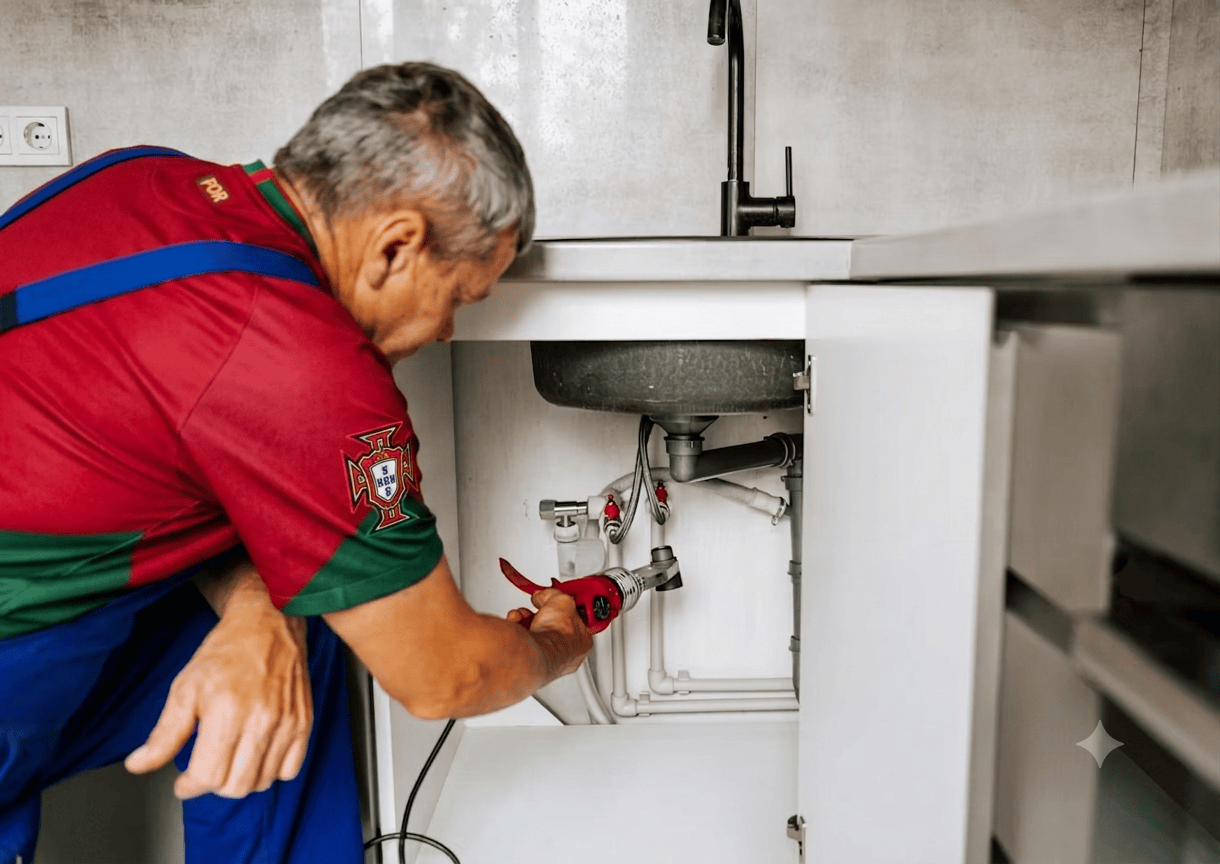
Worth a plumber: a failing pressure reducing valve, a mixer cartridge that has seized or scaled, suspected pipe corrosion in an older property, fitting a booster pump where the incoming supply is genuinely low, and measuring and correcting pressure that is running too high. The common thread is that anything involving the supply side, rather than the fixture, benefits from being diagnosed properly rather than guessed at, because the fixes are more expensive and getting the diagnosis wrong is how people spend money without solving anything.
We work across Tavira and the surrounding freguesias, and the honest first move is almost always the free one: run the five minute test and check your main valve is fully open before anything else. When it turns out to be a PRV, a cartridge or pipework, that is what our plumbing services are for.
Frequently asked questions
Why is my shower weak but the rest of the house is fine?
A single weak fixture with everything else normal is a local problem, not a supply one. In a hard water area the usual cause is a scaled shower head or a blocked handset filter, both of which clear with an overnight soak in vinegar or citric acid. Other possibilities are a kinked hose, a half-closed isolation valve, or a failing mixer cartridge.
Why has the whole house lost pressure?
When several fixtures are weak at once the cause is upstream of them. Check first that the main valve is fully open, since it is often left half-shut after a repair. Beyond that, the common causes are a failing pressure reducing valve, scaled or corroded pipework in an older property, or genuinely low incoming supply, which may need a booster pump.
How do I know if the problem is pressure or a blockage?
Run the five minute test. If the weakness is confined to one fixture, it is almost always a restriction at that fixture, like scale in the head. If it affects fixtures across the house, it is a genuine pressure or supply issue. Comparing one tap against another is what separates the two.
Can hard water cause low pressure?
Yes, in two ways. At the fixture it furs up shower heads and aerators, cutting flow. Inside the system it gradually narrows pipes and scales up cartridges and valves over years. In this region it is the single most common thread behind pressure complaints, which is why descaling is maintenance rather than a one-off.
Is high water pressure a problem?
It can be a serious one, because it stresses joints, hoses and appliance connections and usually gives no warning until something bursts. A failed pressure reducing valve can let full mains pressure into the house. If the pressure has never been measured, a cheap gauge on an outside tap will tell you in a minute whether yours is in the safe range.