Two houses ten minutes apart in the Tavira council area can be supplied with water that differs by a factor of four in hardness. One of them will need a new shower cartridge every couple of years and will watch its water heater lose performance season by season. The other will barely notice. Almost nobody knows which of the two they live in, and that single fact quietly decides how much you spend on plumbing over a decade of owning a home here.
This guide sets out what is actually in the water in this part of the Algarve, what limescale costs in real terms, what to do about it, and where a homeowner’s responsibility begins and ends under Portuguese rules. It is written for the houses we work in every week: town apartments in Tavira, villas out toward Santa Luzia and Conceição, and the many properties that sit empty for months at a time.
How hard is Tavira’s water, really?
Taviraverde, the municipal company that supplies water in the concelho, publishes the answer, and it is more interesting than a single number. Across most of its supply zones the average hardness is around 100 mg/L of calcium carbonate, which sits in the soft to medium band. In the supply zones fed exclusively from boreholes, the average runs at 300 to 400 mg/L, which is firmly hard water. The utility also reports an average pH of roughly 7 to 7.5.
For reference, the classification normally used in Portugal looks like this:
| Total hardness (mg/L CaCO3) | Classification | What you notice at home |
|---|---|---|
| Under 60 | Soft | Soap lathers easily, kettle stays clean for years |
| 60 to 120 | Moderately hard | Light film on the shower screen, occasional descaling |
| 120 to 180 | Hard | Visible crust on aerators, kettle scales within months |
| Above 180 | Very hard | Scale on everything heated, shortened appliance life |
So a Tavira address is not automatically a hard water address. But if your property is on a borehole-fed zone, or on a private borehole of its own, you are potentially at three or four times the hardness of a neighbour on the main supply. None of this is a health concern: hardness is not a drinking water quality problem, and the supply is controlled under Decreto-Lei n.º 306/2007 as amended. It is purely an equipment problem.
To find out where you stand, Taviraverde publishes its analysis results quarterly as editais, on its website and at its customer desk, and you can ask which supply zone serves your address. Their water quality FAQ is the clearest starting point.
Three signs your house is on the hard side of the map
Before you phone anybody, look at the evidence your house is already giving you:
- The kettle test. If a kettle scales visibly within two or three months of being descaled, you are on hard water. If it takes a year or more, you are not.
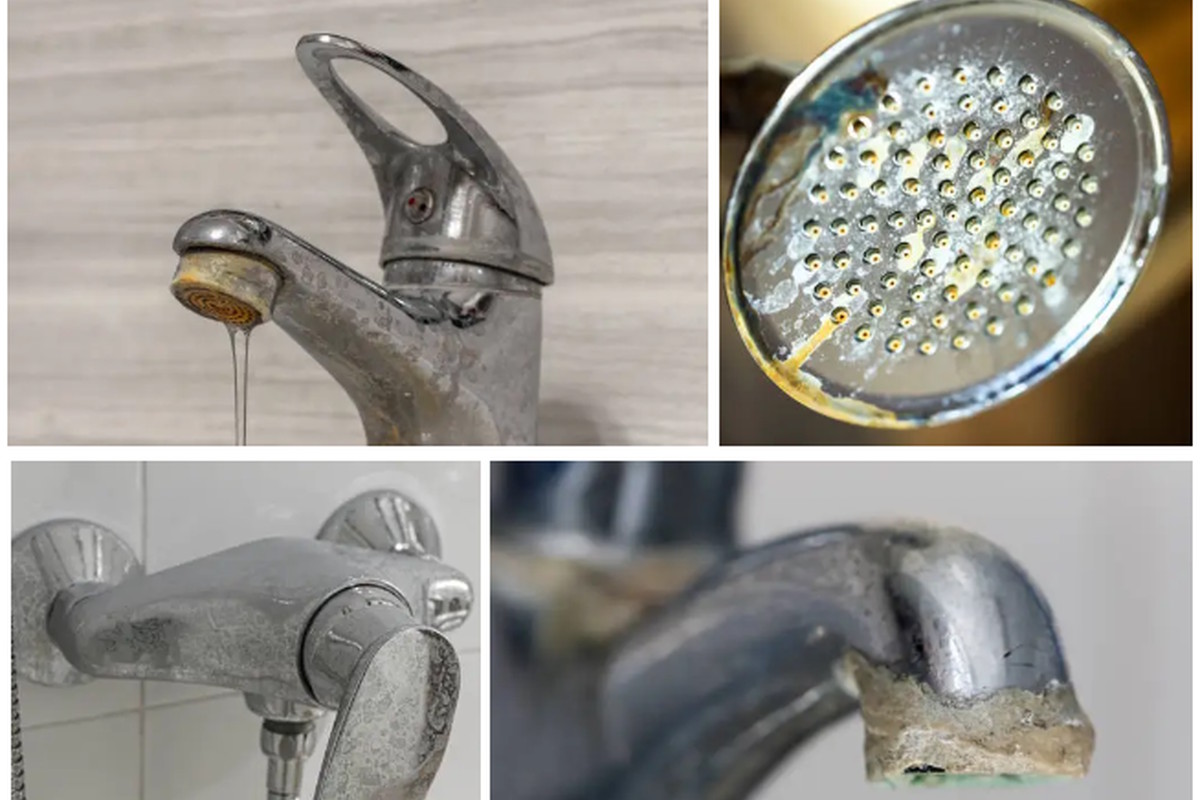
- The spray pattern. Look at your shower head straight on while it runs. Individual jets firing sideways or not at all means the nozzles are blocking. Same for the aerator on the kitchen tap: unscrew it and hold it to the light.
- The soap test. Hard water fights lather. If shampoo and washing-up liquid disappear without foaming, and glassware comes out of the dishwasher with a chalky bloom rather than water spots, minerals are the reason.
A packet of hardness test strips costs a few euros and settles the argument in thirty seconds. It is also the number your dishwasher manual asks for when setting the salt dosage, which most people never adjust.
What limescale actually costs you
Scale matters because calcium carbonate is an excellent thermal insulator, and it forms exactly where you least want insulation: on the surfaces that transfer heat into your water.
The commonly cited industry estimates give a sense of scale, so to speak. The Carbon Trust has put the effect of a 1 mm layer on a heating surface at roughly 7% more energy needed for the same heat output. British Water has estimated a loss of around 12% in heating efficiency at 1.6 mm of build-up. These are approximations rather than laws of physics, and figures vary between studies and equipment, but the direction is consistent and the mechanism is not in dispute.
The practical version: your gas bill creeps up, your hot water runs out sooner than it used to, and the appliance you paid several hundred euros for reaches the end of its life years early.
The second cost is failure. Scale does not simply coat a heat exchanger, it narrows the waterways inside it, which raises internal temperatures and stresses components. That is why heavily scaled water heaters tend not to fail gracefully. They fail on a Saturday in August with a full house.
What scale attacks first in an Algarve home
In the order we typically find them:
- The esquentador or termoacumulador. Symptoms are hot water that swings between scalding and cold during a shower, reduced flow, and a burner that cycles more than it used to.
- Mixer cartridges. Single-lever and thermostatic cartridges are precision parts. Scale makes handles stiff, then makes them drip, then makes them impossible to turn off fully.
- Shower heads and aerators. Cheap to fix, easy to ignore, and a good early-warning system for everything else.
- Washing machine and dishwasher elements. Same physics as the water heater, on a smaller and more expensive-to-replace scale.
- WC cistern valves. This is the expensive one nobody sees. A scaled flush valve that no longer seats properly leaks continuously into the pan, silently, and can waste hundreds of litres a day without a sound you would notice.
- Irrigation and pool top-up lines. Solenoid valves, drippers and float valves all block. In a garden on a timer, the first sign is usually a dead plant rather than a wet floor.
Water pressure: the problem hiding behind the scale
Scale gets the blame for a lot of damage that pressure caused. Portuguese regulation is quite specific here. Under Decreto Regulamentar n.º 23/95, the maximum static or service pressure at any point of use must not exceed 600 kPa (6 bar), measured at ground level. Service pressures at fixtures should fall between 50 and 600 kPa, and the regulation explicitly recommends keeping them between 150 and 300 kPa (1.5 to 3 bar) for comfort and for the durability of the materials. The minimum at the least favourable fixture is 100 kPa, and a pressure reducing valve is required on the introduction branch whenever pressure runs above 600 kPa.
Two things follow from that. First, if nobody has ever measured the pressure in your house, nobody knows whether it complies. A gauge that screws onto a tap costs less than a takeaway and tells you in one minute. Second, the same regulation requires isolation valves in more places than most owners realise: upstream of cisterns, washing machines, dishwashers and water heating equipment, and immediately before and after the meter, plus a check valve and a safety valve on storage water heaters. You almost certainly have more shut-off points than you think. Find them on a calm day, not while standing in water.
High pressure plus scale-narrowed pipework is what turns a braided flexible hose under a sink into a burst. Those hoses have a service life, they rust from the inside at the crimps, and they are the single cheapest thing in a house to replace preventively.
What works against limescale, and what deserves scepticism
Ion exchange softener (descalcificador). The only domestic method that genuinely removes calcium and magnesium from the water. It needs salt topped up and an annual service. Installed prices in Portugal typically run from around 500 euros to 1,500 euros and up, depending on capacity. Worth serious consideration on a borehole-fed property, close to pointless at 100 mg/L. If you fit one, keep at least one unsoftened tap for drinking and cooking.
Polyphosphate dosers. A small cartridge fitted before the water heater that keeps minerals in suspension rather than removing them. Inexpensive, sensible as protection for a single appliance, and needs the cartridge changed on schedule or it does nothing at all.
Magnetic and electronic conditioners. Heavily marketed, and they do not remove hardness. Independent evidence for their effectiveness is mixed at best. If a salesperson demonstrates one at your kitchen table, ask for independent test data before spending significant money. It is also worth knowing that Portugal’s water regulator makes the general point that treating water which does not need treatment is a waste of money and resources.
Periodic descaling. The unglamorous option that works. A technician can descale a heat exchanger or storage cylinder during an annual service, and shower heads and aerators come clean in a bowl of white vinegar or citric acid solution overnight.
One thing not to do. Plenty of advice online suggests dropping your hot water storage temperature to slow scale formation. For a storage cylinder, do not take it below 60°C: stored water held at lower temperatures carries a Legionella risk. Control scale by other means and, if scalding is the concern, deal with it at the outlet with a thermostatic mixing valve rather than by lowering the tank.
The empty-house problem
A large share of properties around Tavira sit closed for weeks or months. Empty houses fail in their own particular ways, and almost all of it is preventable.
Dry traps. In an Algarve summer, the water sitting in a shower or basin trap can evaporate in a matter of weeks, and when it does, the drain becomes an open pipe into your living space. That is the source of the sewage smell that greets returning owners, and the route insects use to get in. Before closing up, run a little water into every drain and add a spoonful of cooking oil, which floats on top and slows evaporation dramatically.
Pressure on things that burst. Close the main stop valve when you leave for an extended period. If that is not practical, at least close the valves feeding the washing machine and dishwasher, since their flexible hoses spend that entire time under full pressure with nobody in the building.
The insurance trap. Portuguese household policies are built around sudden and unforeseen events. Consumer organisation DECO points out that damage from slow infiltration, damp and condensation, and from taps left open (other than after a supply interruption), is typically excluded. A slow leak that ran for three months while you were away is precisely the conversation you do not want to have with a loss adjuster.
Coming back. Expect noise and spluttering from the taps: Taviraverde notes that air in the pipes after a prolonged absence or a supply interruption causes exactly that, and advises running the water for a few minutes until it clears. Run every tap, flush every WC, and give the water heater a full cycle before you rely on it.
How to find a hidden leak in ten minutes
This costs nothing and settles most mysteries about an unexplained bill:
- Turn off every tap and appliance that uses water, including the ice maker and irrigation controller.
- Read your meter, including the small dial or star wheel that registers tiny flows. Photograph it.
- Wait thirty minutes without using any water at all. Read it again.
- If the reading moved, close your internal stop valve after the meter and repeat. If the meter still moves, the leak is between the meter and the house, usually in a buried supply pipe. If it stops, the leak is inside the building.
For the cistern specifically, drop food colouring into the tank, wait twenty minutes without flushing, and look in the pan. Colour in the pan means the flush valve is passing water. Also worth checking: warm patches on a tiled floor, which point to a hot water leak inside a slab, and a booster pump that starts up on its own when no tap is open.
If the meter is moving and you cannot find the source, that is the moment to call somebody with leak detection equipment rather than start opening walls. Our team covers this across the concelho at Tavira Services Plumbing.
Who pays for what: where the public network ends
This catches out a lot of owners, particularly those who bought recently. The connection branch, the ramal de ligação, runs from the public main to the boundary of your property and is part of the public system, installed by the utility. The dividing line is normally the isolation valve placed in the street at the property limit. There is also a stopcock immediately before the meter that is reserved for the utility’s own use.
Everything downstream of that boundary is the private network, and the owner is responsible for its conservation, repair and renewal. In practice: a burst in the street is the utility’s problem, a burst on your side of the boundary valve is your bill, and water lost through it is metered and charged to you. Which is the entire argument for the ten-minute meter test above.
What your insurance actually covers, and the 8-day form
Water damage is consistently among the most common claims on Portuguese multirriscos habitação policies. Cover typically applies to sudden and accidental events arising from the internal water and drainage installations. What varies significantly between policies is whether pesquisa de avaria (tracing the fault) and making good afterwards, meaning the tiles, plaster and paint, are included in the base cover or sold as an extension. Check yours before you need it.
If the water came from a neighbouring flat, or yours was the source, there is a specific instrument for it. Under an industry protocol coordinated by the Associação Portuguesa de Seguradores, both parties complete and sign a Declaração Amigável de Danos por Água (DADA) and send it to their respective insurers within 8 days. It works much like the motor accident equivalent: signing it is not an admission of liability, it simply records the facts, and your own insurer handles your claim and then recovers from the other insurer. It exists precisely to stop these situations turning into a two-year argument in a condomínio meeting.
The gas inspection nobody remembers
While we are on the subject of hot water, this is the most frequently missed obligation we encounter in Algarve homes. Periodic inspections of gas installations are mandatory and must be carried out by an inspection body authorised by the DGEG:
- Every 5 years for residential installations that are more than 10 years old and have not been remodelled.
- Every 3 years for buildings in public-use categories, which include the hotel and restaurant classifications. If your property operates commercially, confirm which category applies to it rather than assuming the residential cycle.
The detail that catches people: replacing or installing an esquentador, boiler or hob triggers an extraordinary inspection, and the countdown to the next periodic one restarts from that date. Fitting a new water heater does not, by itself, renew the certificate for the whole installation. If the deadline passes, the DGEG can notify you to regularise within three months, after which your supplier can move toward cutting the supply. Residential inspection certificates are valid for five years, which also makes them worth asking for when buying a property.
A maintenance calendar for a Tavira home
| Frequency | What to do |
|---|---|
| Monthly | Glance under every sink for damp. Run taps and flush WCs in unused bathrooms. |
| Quarterly | Descale shower heads and aerators. Check flexible hoses for rust, bulges or weeping at the crimps. Run the food colouring test on each cistern. |
| Annually | Service the esquentador or boiler, including descaling. Measure pressure at a tap. Check the pressure reducing valve and expansion vessel if fitted. Service the softener. |
| Every 5 years | Gas inspection where applicable. Replace flexible connection hoses as a matter of course. On properties over about 30 years old, have the condition of the pipework assessed rather than waiting for the first burst. |
| Before closing up | Close the main stop valve, oil the traps, isolate appliance feeds, and leave a key with someone who can act if a neighbour reports water. |
When to call a plumber
Descaling a shower head is a Saturday morning job. These are not:
- The meter moves with everything closed and you cannot locate the source.
- Hot water temperature swings, or flow has dropped noticeably at every hot tap.
- Measured pressure above 6 bar, or below roughly 1 bar at the worst-served fixture.
- Any smell of gas, or a gas appliance that has not been inspected within its cycle.
- Damp appearing on a wall or ceiling shared with a neighbour, where the DADA process may apply.
We are a local team working across Tavira and the surrounding freguesias, and we would rather look at a small problem in March than a large one in August. You can see what we cover and request a quote at plumbers.taviraservices.pt.
Frequently asked questions
Is Tavira tap water safe to drink?
Yes. It is treated and monitored under national legislation, with results published quarterly, and hardness is not a health parameter. Hard water is an equipment issue, not a safety issue. The utility’s own guidance also cautions against buying domestic treatment equipment for water that does not need treating.
Do I need a water softener in Tavira?
Find out your hardness first. On a supply zone averaging around 100 mg/L, a softener is difficult to justify. On a borehole-fed property in the 300 to 400 mg/L range, the payback in appliance life and energy is a much more serious calculation.
Why does my hot water run out faster than it did last year?
The most common cause we find is scale in the heat exchanger or on the element, which reduces both efficiency and effective capacity. A descaling service during an annual maintenance visit usually recovers most of it, provided you do not leave it until the unit fails.
There is a leak in the street outside my house. Who fixes it?
Up to the boundary of your property, normally marked by the isolation valve at the property limit, it belongs to the public network and the utility. Past that point it is the owner’s responsibility.
My neighbour’s leak damaged my ceiling. What do I do first?
Photograph everything, stop the source if you safely can, and raise the DADA with your neighbour. Both of you sign it and send it to your own insurers within 8 days. Your insurer then handles your claim directly rather than sending you to argue with theirs.