A buyer viewed a house in Tavira in February, fell for the terrace, and completed in April. In July the ground floor smelled of drains, the water heater gave four minutes of hot water, and a damp patch appeared on the hall wall. None of that was hidden. All of it was visible in February to anybody who knew where to look.
Portugal has no equivalent of the British homebuyer survey. There is no standard report, no surveyor waiting to be booked, and nothing in the buying process that obliges anyone to look at the plumbing. The estate agent will not check it. The notary will not check it. The bank valuation looks at the market value of the property, not at the condition of the pipes inside it.
So the check falls to you. This guide is what we would look at in a house here before anybody signs a contrato de promessa, written by people who spend their week inside these buildings. It takes about forty minutes if you do it yourself, and the whole point is that it costs far less than what it finds.
Why an Algarve house needs a different checklist
Generic advice about buying property is written for generic houses. Around Tavira, four local conditions do most of the damage, and each of them leaves fingerprints you can learn to read.
Water in this region is hard, and in the supply zones fed by boreholes it is very hard indeed. That means scale, and scale means water heaters that underperform and pipework that narrows over decades. If you want the full picture on that, we covered it in our guide to hard water in Tavira.
Many properties stand empty for months at a time, which is its own category of damage: traps dry out, seals perish, stopcocks seize. Older town houses in the historic centre often still contain decades-old galvanised steel pipework that corrodes from the inside. And out toward Santo Estêvão, Luz de Tavira and Conceição, a large share of rural properties do not connect to mains water or mains drainage at all, running instead on a borehole and a septic tank, both of which carry paperwork that most buyers never think to ask about.
None of these are reasons not to buy. They are reasons to know the number before you agree the price.
The forty minute walk through
Do this on the second viewing, not the first. Bring your phone, and photograph everything.
Ask them to run the water for ten minutes before you arrive. This one request defeats most of the staging. A house that has had every tap run for ten minutes tells the truth about pressure, temperature stability and discoloured water. A house tested cold from standing tells you nothing.
Then, in order:
- Open the furthest tap from the entrance and the shower at the same time. Watch the flow drop. A significant collapse when two outlets run points at scaled or undersized pipework.
- Run the hot water for a full five minutes. Time how long it stays hot. Note whether the temperature swings. Four minutes of hot water in a house with two bathrooms is a problem you will inherit.
- Flush every WC, twice. Watch the bowl afterwards for a trickle that never quite stops.
- Unscrew one tap aerator. Hold it to the light. It is the cheapest hardness test in existence.
- Look under every sink with your phone torch. You are looking for white mineral crusting, green corrosion on brass, rust at the crimps of flexible hoses, and any repair done with tape.
- Put your hand flat on the wall below every bathroom and behind every shower. Cold and slightly damp is worth a photograph.
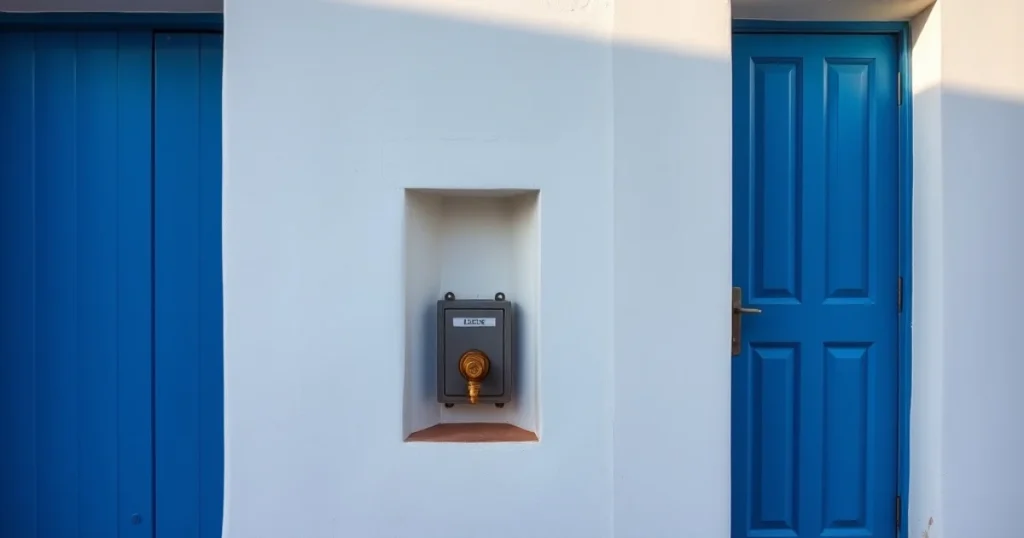
- Find the stopcock and turn it. If the seller does not know where it is, that tells you how the house has been maintained. If it will not turn, budget for it.
- Smell the drains in any room that has been closed up. Dry traps are trivial to fix, but a persistent smell after the water has been run points at something structural.
The meter test, which nobody does
This is thirty minutes of doing nothing and it is the single most valuable test on this page.
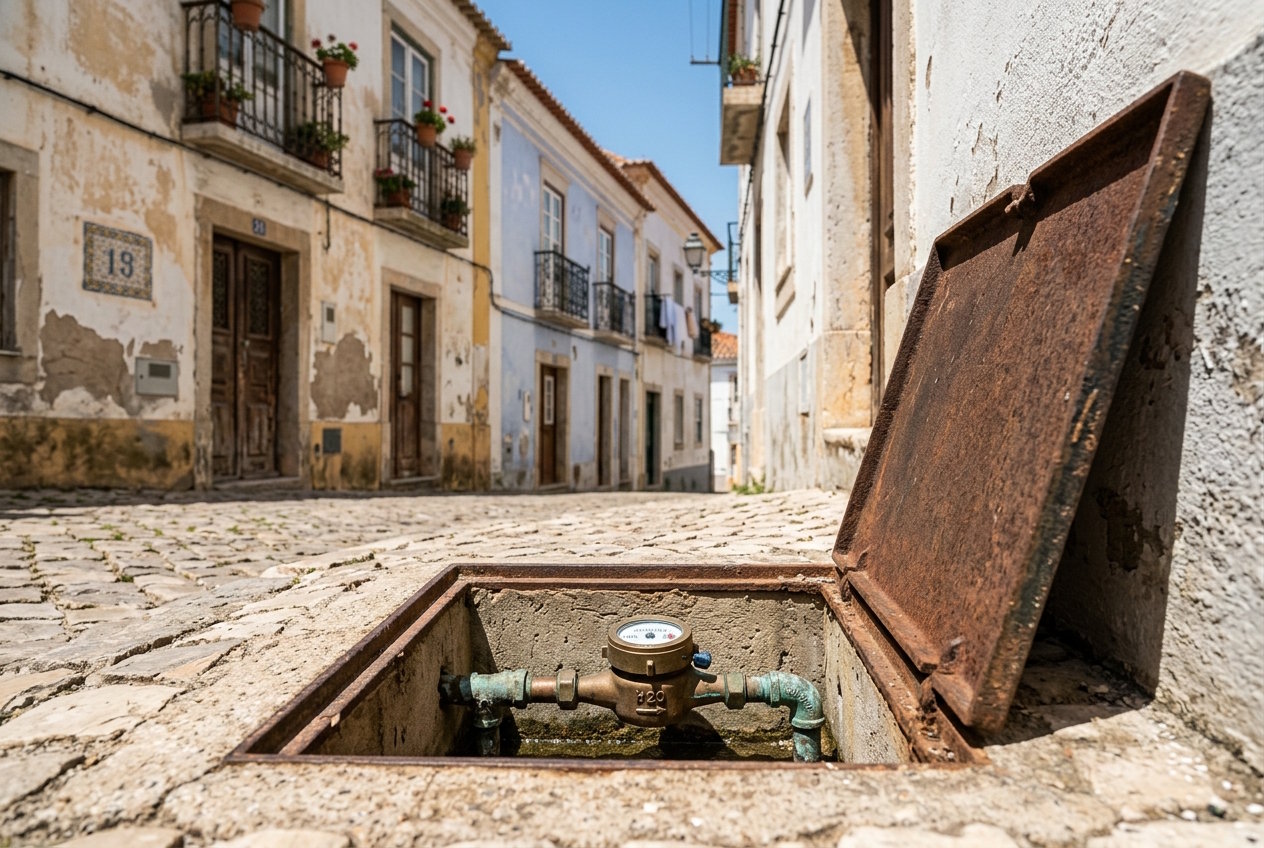
Close every tap and appliance in the property. Photograph the water meter, including the small dial that registers minimal flow. Wait half an hour without using a drop. Photograph it again.
If the reading moved, water is going somewhere. In an occupied house that might be a passing cistern valve. In an empty house it is more likely a buried leak, and buried leaks in this region are usually found under a floor slab or in a garden supply run. Either way it is now a negotiating point rather than a surprise you pay for in September. If you cannot locate it, that is exactly what leak detection equipment is for, and it is far cheaper than opening walls to look.
The hot water system: what actually matters
Hot water is the most expensive thing to get wrong, because replacement is disruptive and because the failure mode is seasonal, arriving exactly when the house is full.
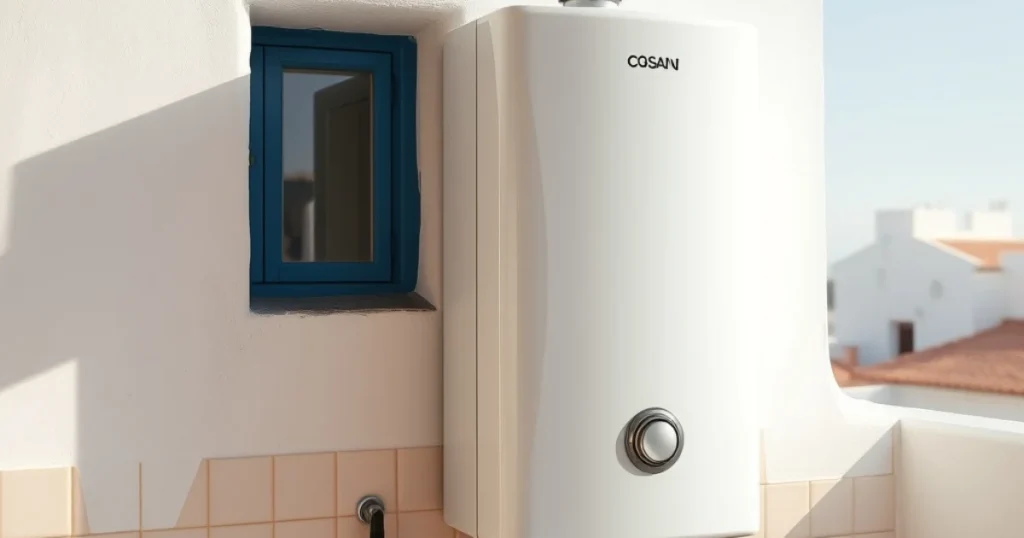
First establish what it is. An electric storage cylinder, a termoacumulador, is a tank with a heating element and a sacrificial anode inside it. A gas esquentador heats on demand with no storage. Solar thermal and heat pump systems add a cylinder and a backup circuit.
| Look for | What it means |
|---|---|
| Date or serial on the unit label | Most cylinders have a practical life around 10 to 15 years, less on hard water |
| Rust staining below the unit | Tank corrosion, which is not repairable |
| Constant drip from the safety valve discharge | Pressure or valve fault, sometimes both |
| Rumbling or popping while heating | Sediment and scale on the bottom of the tank |
| Breaker that has tripped before | Often a scaled element that has cracked its sheath |
| Hot water that runs out fast | Scale reducing both efficiency and effective capacity |
Photograph the label with the model number. It is the single most useful photograph you will take in the whole viewing, because it lets anyone tell you the age, the capacity and the replacement cost without setting foot in the house. Our water heater page lists what repair and replacement work costs, so you can put a number on it before you negotiate.
One warning that applies specifically to gas. If the property has a gas esquentador, boiler or hob, ask for the gas inspection certificate. Periodic inspections are mandatory, carried out by a body authorised by the DGEG, and residential certificates are valid for five years. A seller who cannot produce one is not necessarily hiding anything, but you are inheriting both the cost and the deadline.
Drains, and the question to ask before anything else
Start with the question that determines everything downstream: is the property on mains drainage, or on a septic tank?
Ask it plainly, and do not accept a vague answer. In and around Tavira town it will almost always be mains. Out in the campo it very often is not, and a surprising number of sellers are genuinely unsure.
On mains drainage, your checks are simple. Lift the outside inspection chamber covers if you can. Standing water or visible debris in the chamber means the run is not clearing properly. Ask whether drains have ever been jetted, and how often. Recurrent blockages in an older property are usually structural rather than behavioural, which is why a camera inspection during drain work is worth paying for once rather than paying for the same blockage every year.
Septic tanks: the paperwork nobody asks for
If the answer was septic tank, this section is the most valuable page of your due diligence, and it goes well beyond plumbing.
A septic tank in Portugal is not simply a private matter. Rejecting waste water with infiltration into the soil requires a water resources use permit from the environmental authority, and installation is subject to municipal rules on siting, including minimum distances to buildings, wells, property boundaries and water lines. A correctly built tank is a sealed, compartmented reservoir, and the outflow is supposed to receive complementary treatment sized against a percolation test of the actual soil.
So the questions to ask, in writing, before you commit:
- Is there a permit, and can I see it?
- Where exactly is the tank, and where is the infiltration area? Ask them to show you on the ground, not on a plan.
- When was it last emptied, and by whom? Ask for an invoice. A tank nobody can date is a tank nobody has emptied.
- Is there a borehole, and how far is it from the tank and the infiltration area?
- How close is the public sewer?
That last question has a sting in it that catches buyers every year. Where a public network becomes available within a short distance of the property boundary, commonly framed as 20 metres, connection becomes obligatory and private solutions have to be abandoned: the tank disconnected, emptied, disinfected and filled in, and boreholes for drinking water given up too. Permits already issued can be reviewed or revoked once the public network reaches you.
Translated into money: if the sewer is coming down that road, you are buying a connection cost, a decommissioning cost, and possibly a new internal drainage run. If the sewer is nowhere near, you are buying a maintenance obligation instead, because while no network is available the utility is bound to provide sanitation by mobile means, meaning tanker emptying, which you pay for and schedule. Either answer is fine. Not knowing which one you bought is not.
Boreholes and private water
Plenty of quintas around Tavira draw water from a furo. It works well, and it is one of the reasons rural property here is attractive. But it comes with three things a buyer should establish.
The paperwork. Private groundwater abstraction sits under the Water Law and the associated licensing regime. Requirements vary with the use, the extraction power and whether the water is for human consumption, and prior communication to the licensing authority is expected before use. Ask what exists and get copies. If nothing exists, factor in the regularisation.
The water itself. Ask for a recent analysis. Borehole water in this region trends much harder than the municipal supply, and hardness is an equipment question rather than a health one, but nitrates and bacteriological quality are health questions and you want them tested rather than assumed.
The equipment. A borehole system is a pump, a pressure vessel and a control set, all of which have finite lives and none of which are cheap to replace in a hurry. Ask when the pump was last changed and listen for whether it cycles on and off repeatedly when a single tap runs, which usually indicates a failing pressure vessel.
Bathrooms: what a renovation really costs you
Buyers routinely budget for a bathroom on the basis of what the tiles and the suite cost. That is the smaller half of the job in an older Algarve property.
The questions that move the number are underneath: whether the existing waste runs can stay where they are, whether the supply pipework is being replaced at the same time, whether the floor needs waterproofing, and whether moving the WC by a metre means chasing into a structural slab. A bathroom that keeps its layout is a fundamentally different project from a bathroom that moves.
The practical advice is to get a plumber to look at it during the buying process rather than after, because the answer changes what the house is worth to you. A quote for a bathroom installation based on the actual pipework is a negotiating document. A guess is not.
If you are buying to rent it out
Alojamento local changes the risk profile completely, because in a rental the failure happens while strangers are in the house and you are not.
Three things are worth checking before purchase rather than after the first booking. Whether the hot water capacity matches the maximum occupancy you plan to advertise, because six guests and a fifty litre cylinder is a guaranteed complaint. Whether every appliance feed has its own isolating valve, so a burst hose does not mean shutting off the whole house mid stay. And whether there is a shut-off the cleaner or key holder can actually reach and knows about.
Absent owners generally do better with a standing arrangement than with emergency numbers, which is the whole idea behind holiday rental plumbing cover and pre-season checks. The cost of a check in May is trivially small next to one cancelled booking in August.
Documents to ask for, even though nobody will demand them
Since January 2024, Portuguese rules no longer require the ficha técnica de habitação or the licença de utilização to be produced at the deed. That change was made to speed up transactions, and it removed a safety net that used to catch problems automatically. It did not remove your right to ask, and the professional consensus is that buyers should still request these documents during negotiation, before signing a promissory contract.
| Document | Why it matters for the plumbing |
|---|---|
| Ficha técnica de habitação | Describes the technical characteristics of the building, where it exists. Broadly applies to properties whose use licence was applied for after 30 March 2004 |
| Licença de utilização | Confirms the building is legally what it claims to be, which matters if extensions were plumbed in later |
| Gas inspection certificate | Mandatory periodic inspection by a DGEG-authorised body, residential certificates valid five years |
| Septic tank permit and last emptying invoice | Establishes whether the system is legal and maintained |
| Borehole registration or licence | Establishes whether the water supply is legal |
| Recent water and electricity bills | An unexplained water bill is a leak nobody mentioned |
| Invoices for past plumbing work | Repairs to buildings carry a five year guarantee period, and it transfers |
That last row deserves a moment. Under the Civil Code, an empreitada covering the repair of a building carries a guarantee window of five years from delivery, and it applies to subsequent acquirers, not only to the person who commissioned the work. If the bathroom was redone eighteen months before you bought the house, that repair may still be under guarantee. The invoice is what proves it existed, which is why asking for past invoices is not nosiness, it is money.
Twelve red flags, ranked by what they cost
Cheap to fix, and mostly cosmetic:
- Scaled shower heads and aerators
- Dry traps and drain smell in a house that has stood empty
- A single dripping tap or a passing cistern valve
- Perished flexible hoses under sinks
Moderate, and worth quantifying before you agree a price:
- A water heater over ten years old, or one that runs out fast
- Pressure that collapses when two outlets run
- Recurrent drain blockages the seller mentions casually
- A seized stopcock, or nobody knowing where it is
Expensive, and a reason to bring somebody in before committing:
- Damp on a wall shared with a bathroom, or a warm patch on a tiled floor
- A meter that moves with everything closed
- A septic tank with no permit, no known location, and no emptying history
- Visible galvanised steel pipework in an older town house, particularly with brown water after a period of standing
What a pre-purchase plumbing check involves
If the walk through turned up two or three items from the bottom of that list, it is worth having somebody look before you sign rather than after. A plumbing inspection is not a formal survey and it does not produce a legal document. What it produces is a list of what needs doing, what it costs, and what can wait, which is precisely what you need in a price negotiation.
We do these across Tavira, Cabanas, Santa Luzia, Conceição, Luz de Tavira and Santo Estêvão. You can see the full coverage area and what our call-out and common jobs cost on the prices page, so there are no surprises there either. If the house you are looking at is a serious candidate, sending a few photographs on WhatsApp is usually enough for us to tell you whether it is worth a visit at all.
And if you have already bought and something on this page just described your house, that is what emergency plumbing and the rest of the service list exist for. Most of what is on it started as something somebody chose not to look at.
Frequently asked questions
Is there a house survey system in Portugal like in the UK?
Not in the same form. There is no standard homebuyer report, and no step in the buying process obliges anyone to inspect the condition of the building. Bank valuations assess market value rather than condition. Buyers who want the equivalent commission their own inspections, which is why doing the walk through yourself is worth the forty minutes.
Do I still need the ficha técnica de habitação when buying?
It has not been required at the deed since January 2024, along with the licença de utilização. The documents still exist and buyers are still advised to request them during negotiation, before signing a promissory contract, because the removal of the formality did not remove the underlying problems it used to reveal.
The house has a septic tank. Is that a problem?
Not in itself, and it is normal on rural properties without mains drainage. What you need is the permit, the location, the last emptying invoice, and the distance to the nearest public sewer. If the network reaches within a short distance of your boundary, connection becomes obligatory and the tank has to be decommissioned properly, which is a cost worth knowing about before you agree a price rather than after.
How old is too old for a water heater?
Treat anything past ten years in this region as a unit approaching replacement, and anything past fifteen as a replacement you are buying. Hard water shortens the life of both the element and the tank, so age matters more here than the manufacturer’s expectations suggest. Photograph the label and you can price it before you negotiate.
Can I get plumbing work checked before I sign the contrato de promessa?
Yes, and that is the right moment for it, since the promissory contract is where the price and conditions are fixed. You need the seller’s agreement for access, which is normal and rarely refused. A seller who refuses a plumbing inspection has told you something useful for free.