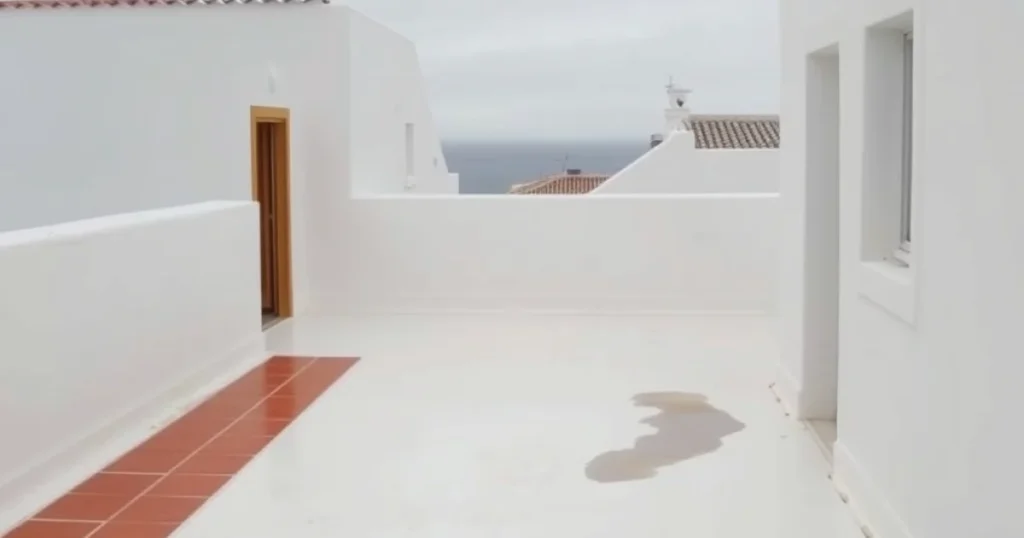
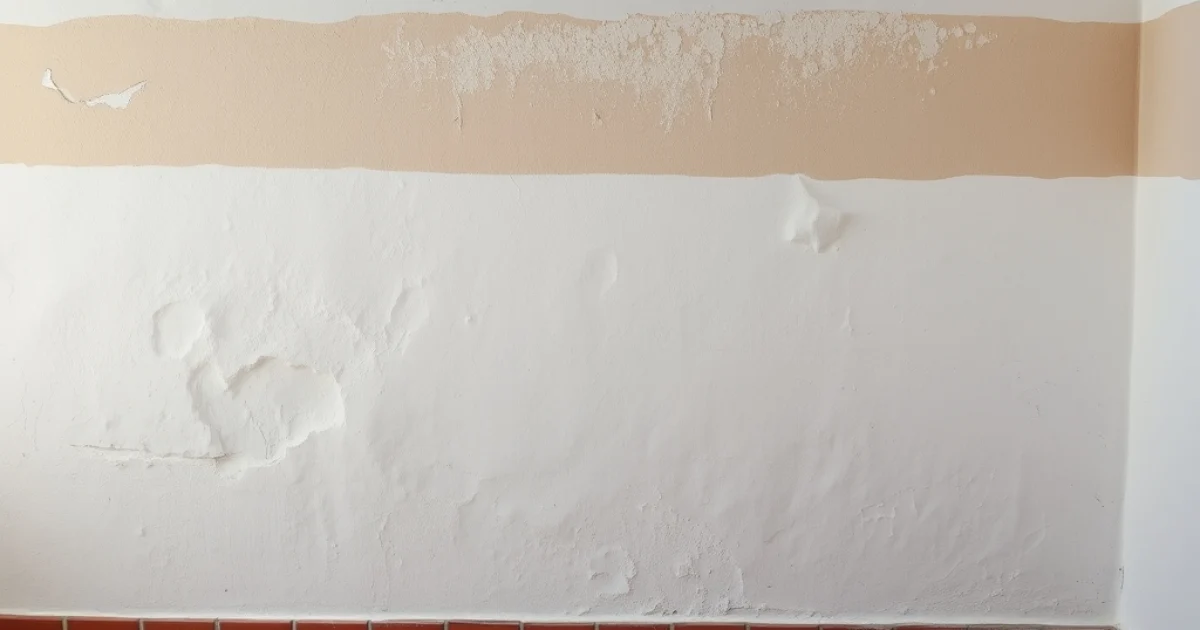
Salt damp, salitre in Portuguese, is groundwater rising through an old wall and carrying dissolved salts with it. When the water evaporates at the surface, the salts crystallise as a white bloom and push off whatever is on the wall. Painting over it always fails because the paint does not stop the water or the salts: within a winter or two the bloom is back and the new paint flakes off with it.
It is one of the most common problems in older houses around Tavira, and one of the most often treated the wrong way. Owners see white powder and flaking paint at the bottom of a wall, assume it is mould or a leak, scrape it, paint it and watch it come back. The fix starts with knowing which of three different problems you actually have.
Three problems that look alike
Salt damp, condensation and water coming in from outside all make walls look damp, and all of them ruin paint. They have different causes and different cures, and treating one as another is why so many repairs fail.
Condensation is the subject of a separate article, why Algarve houses grow mould in winter, and it is not salt damp, even though owners often call both humidade. This article is about the first column.
Why old Algarve houses get salt damp
Most houses built before the 1970s in the eastern Algarve have no damp proof course, the barrier modern walls have just above the ground. Their walls are stone, rubble or earth, often set in lime mortar, and they sit directly on the soil. Water in the ground rises through them the way it rises through a sugar cube.
That water is rarely pure. Near the coast and the Ria Formosa, in Cabanas, Santa Luzia and the lower parts of Tavira, the ground carries salts, and so does the sand used in old mortars. As the water reaches the surface of the wall and evaporates, it leaves those salts behind. They build up, crystallise and expand, and that is what pushes the paint and the plaster off.
Later changes often make it worse. A cement render on the outside, a concrete floor laid against the wall, a terrace or a pavement raised above the old ground level: each one closes a route the wall used to dry through, so the water climbs higher inside.
Why painting over it always fails
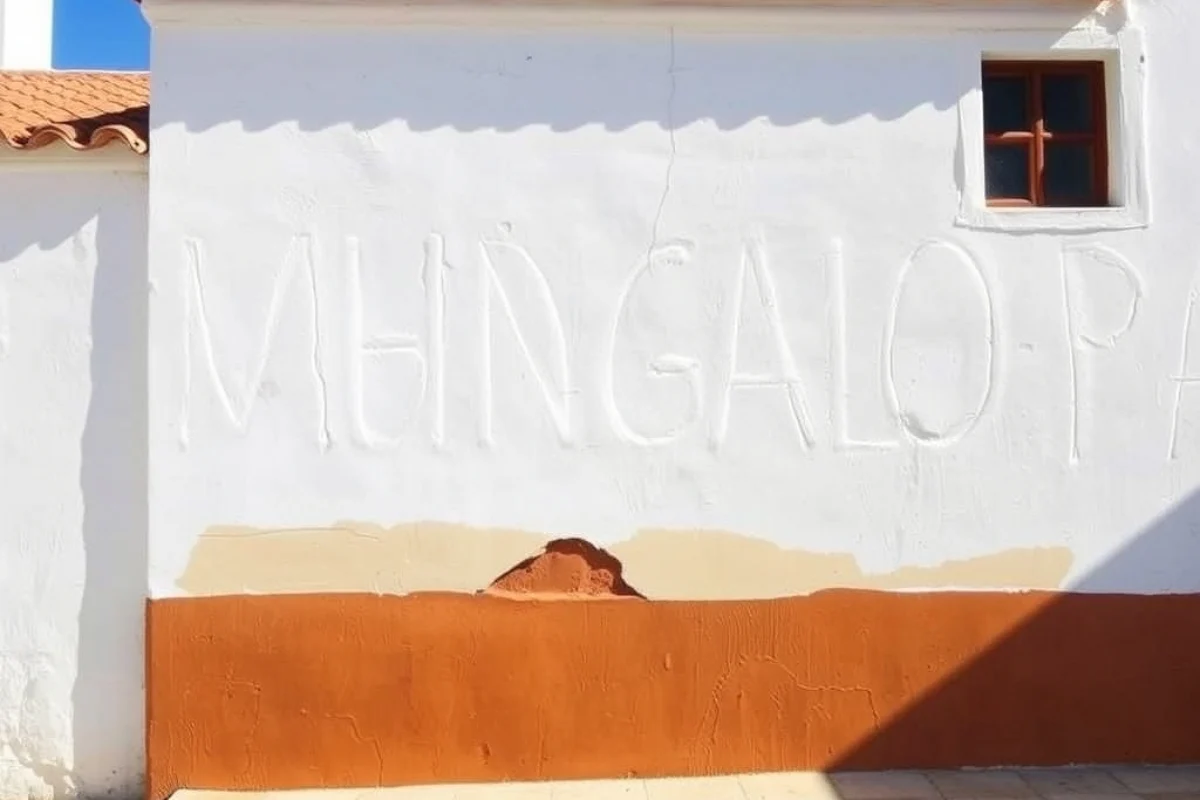
Ordinary acrylic and plastic paints form a film. On a dry wall that is fine. On a wall with salt damp, the film traps the moisture behind it, the salts crystallise between the plaster and the paint, and the film blisters and lifts. Scraping the white powder off and repainting resets the clock for a few months, nothing more.
Anti damp paints sold as a quick fix have the same limit if they seal the surface. They can hold the stain back for a while, but the water and the salts are still in the wall, and they come out somewhere else, usually just above the painted area.
The rule is simple: if the wall needs to dry, whatever goes on it has to let it breathe.
What the treatment involves
A proper repair follows the same order every time.
- Diagnosis. Moisture readings and a look at the outside of the wall, the ground level, the drainage and any pipe or gutter nearby, to confirm it is salt damp and not water coming in.
- Remove the salty plaster. The damaged plaster is cut back, usually some way above the visible damage, because the salts are spread further than they show.
- Treat and dry. The masonry is treated against the salts and left to dry before anything new goes on.
- A breathable, salt resistant render. The new render is chosen to let moisture out and hold the salts away from the surface.
- Breathable paint. Two coats of a vapour permeable paint, never a plastic one that seals the wall again.
Where the cause is outside, it is dealt with first: a pavement lowered away from the wall, a gutter that empties onto the base of the wall redirected, a garden bed moved back. Without that, any repair inside is fighting the same water.
How long it takes
Time is the part people underestimate. On the published timings of Tavira Painters – Painting Services, a single wall usually takes one to two days plus around 24 hours of drying, and a whole room three to four days. Rushing that, to paint a wall before guests arrive, is the most common reason a salt damp repair fails early.
The best time of year for the work is late spring to early autumn, when walls dry fastest. A wall treated in a wet January will dry, but more slowly.
What it costs in November 2026
These are the average labour prices published by the painters, checked in November 2026. A diagnosis visit on its own costs 95 euros and includes moisture readings and a written treatment plan. A single wall repair of up to 5 square metres costs 290 euros, and a room treatment of up to 20 square metres costs 590 euros. Treatment products and render are charged at cost on top of the labour. The prices do not include VAT.
These figures are averages, and they vary between interior and exterior work. Every wall is different, and the final price depends on how far the damage goes, what the wall is made of and whether anything outside has to be changed first. That is why every quote is made after a site visit. The visit has a travel charge, stated in advance, and that charge is included in the price if the work goes ahead.
The work carries a 12 month guarantee: if the damp returns in the same place and the source has not changed, the area is treated again. You can read how the job is done on the salt damp and humidity repairs page of Tavira Painters – Painting Services.
Buying an old house with salt damp
Salt damp is not a reason to walk away from an old house in Tavira or Conceição. It is common, it is treatable, and many of the most beautiful houses in the area have it somewhere. What matters is knowing how much there is before you agree a price.
Look at the bottom of every wall, inside and out, including behind furniture and inside built in cupboards, which is where a fresh coat of paint hides the most. Ask when the walls were last painted: a whole house painted just before a sale deserves a closer look. Smell the rooms that have been closed. And if you see a raised pavement, a concrete floor or a cement render against old stone walls, expect damp behind it.
A diagnosis visit before you sign gives you a realistic idea of which walls need work and roughly what it will cost, which is a far better basis for a negotiation than a guess.
When it is not salt damp
Some walls look like salt damp and are something else. A damp patch that keeps growing, especially if it is warm to the touch or near a bathroom or kitchen, can be a leaking pipe inside the wall. In that case the first step is the water meter test, which we explained in how to find a hidden leak in an Algarve house, and the job is for a plumber before any painter.
A stain at the top of a wall or on the ceiling, after rain, is water coming in from a terrace, a roof or a window, and it needs waterproofing or a repair outside. Black spots in corners are condensation. And a white powder on new brick or render, that brushes off and does not come back, is often just the salts from the building materials themselves coming out as the wall dries for the first time.
Frequently asked questions
What is salitre on a wall?
It is salt damp: groundwater rising through an old wall and leaving salts behind when it evaporates. You see it as white powder or crystals and flaking paint in a band at the bottom of the wall.
Can I just paint over salt damp?
No. Ordinary paint traps the moisture and the salts behind it, and within a winter or two it blisters and flakes again. The salty plaster has to be removed and the wall finished with breathable materials.
How do I know if it is salt damp or condensation?
Salt damp is a band at the base of the wall with white powder and crumbling plaster, present all year. Condensation is black spots in cold corners and around windows, mostly in winter.
How much does salt damp treatment cost in Tavira?
On average labour prices checked in November 2026, a diagnosis is 95 euros, a single wall up to 5 square metres is 290 euros and a room up to 20 square metres is 590 euros, without VAT. Materials are extra, and every quote comes after a site visit.
Do I pay for the site visit?
The visit has a travel charge, stated in advance, and it is included in the price if the work goes ahead. A diagnosis on its own, with readings and a written plan, costs 95 euros.
How long does a salt damp repair take?
Usually one to two days for a single wall, plus around 24 hours of drying, and three to four days for a room. Painting before the wall has dried is the most common reason the repair fails.