You land in Faro in April, drive to the house, open the door, and the smell hits you before you have put the bags down. Nothing has leaked. The roof is fine. But there is black speckling on the north wall of the back bedroom, a grey bloom on the leather sofa, and the inside of the wardrobe smells like a cellar.
Almost every owner who leaves a house here from October to April meets this at some point, and almost every one of them reaches the same wrong conclusion: that there must be a leak somewhere. There usually is not. What you are looking at is condensation, and it is a ventilation and surface temperature problem rather than a plumbing one.
The good news is that it is preventable, cheaply, and that fixing it properly is a day of work rather than a building project. The bad news is that the standard reaction, which is to bleach the wall and repaint it, guarantees it comes back next winter.
Why this happens in a warm country
People assume damp is a northern European problem. The Portuguese housing stock says otherwise, and the numbers are genuinely surprising.
Eurostat data indicates that around 69% of buildings in Portugal have no effective thermal insulation, and roughly a quarter of homes report leaks or damp problems, one of the highest rates in the European Union. In 2023 Portugal ranked second in the EU for people living in housing with leaks and damp. Around 16% of the population say they cannot keep their home adequately warm in winter.
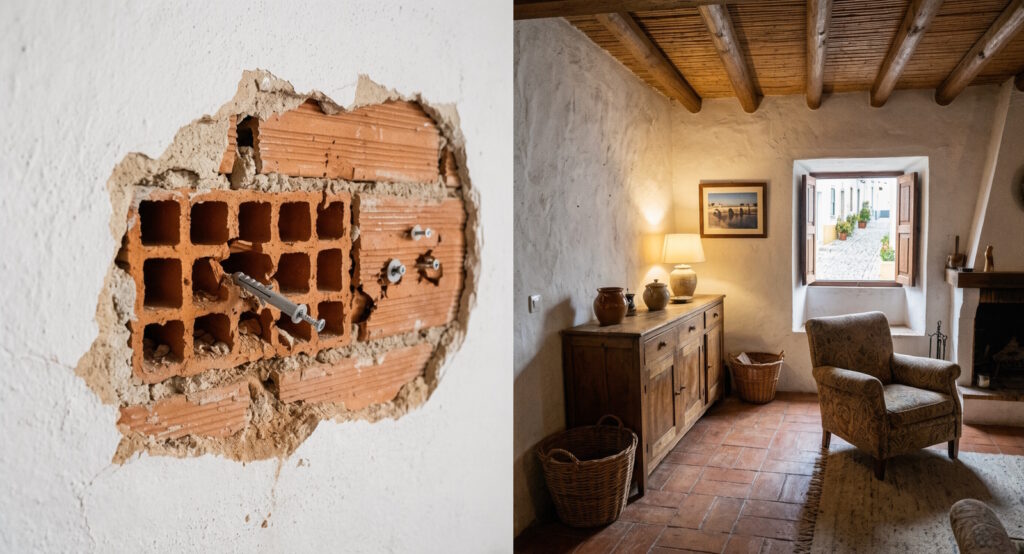
A mild climate is precisely what caused this. Houses here were built to shed summer heat, not to hold winter warmth. Solid masonry, single glazing, no cavity, no insulation and no heating system, because for most of the year none of it is needed. Then between December and February the wall temperature drops, the air inside is still carrying moisture, and the two meet.
The mechanism, in one paragraph
Warm air holds more water vapour than cold air. When air touches a surface colder than its dew point, it can no longer hold that vapour and the water comes out onto the surface. That is condensation. It appears first on the coldest surfaces in the building, which is why you find it on single glazed windows, in corners where two external walls meet, on north facing walls that never see sun, and behind furniture pushed flat against an outside wall where no air circulates.
Mould then grows on the moisture, not on the wall. That distinction matters, because it explains why cleaning the mould without changing the conditions is a temporary result every time.
Mould is not the problem. It is the symptom telling you a surface is staying wet.
Indoor relative humidity in a comfortable house sits roughly between 45 and 65%. A closed house in an Algarve winter, with nobody opening a window for five months, routinely runs well above that.
Condensation, rising damp or a leak? How to tell
Getting this right decides whether you spend two hundred euros or five thousand, so it is worth five minutes of looking.
| Sign | Points to |
|---|---|
| Black speckled mould in corners, on ceilings, behind wardrobes, around window reveals | Condensation |
| Worse on north facing walls and in the coldest rooms | Condensation |
| Water running down the inside of the glass in the morning | Condensation |
| A tide mark rising from floor level, roughly to a metre, with salty white crystals | Rising damp |
| Paint blistering and plaster crumbling near the skirting | Rising damp |
| A defined patch that grows, with a clear centre, often on a ceiling or beside a bathroom | Leak |
| A patch that is warm to the touch | Hot water leak |
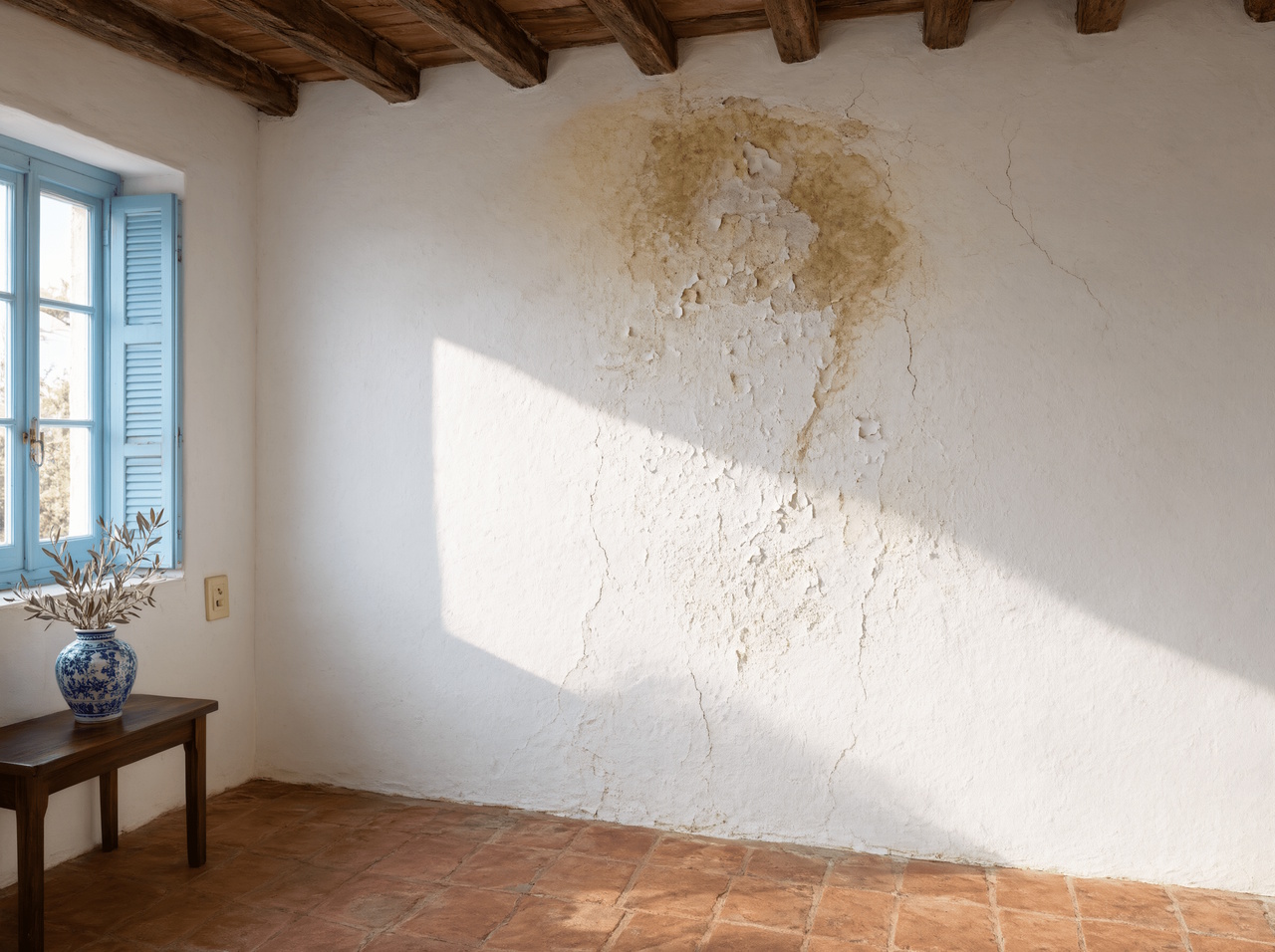
| Damp appearing only after heavy rain, near a window, chimney or roof edge | Water ingress, not condensation |
The distinction is worth being firm about, because there is a small industry in Portugal built on selling expensive chemical injection treatments for rising damp to people who actually have condensation. If the damp is at head height in a corner rather than at floor level, it is not rising from the ground.
If it does look like a leak, and particularly if it is near a bathroom or has a warm patch, that is a different trade. Our sister site covers leak detection, and the meter test in our hard water guide will tell you in thirty minutes whether water is going somewhere it should not.
Where it always appears in an Algarve house
After enough spring openings, the list is depressingly consistent.
- Behind the wardrobe on an external wall. The single most common location. No airflow, coldest surface in the room, and nobody looks there until they smell it.
- Inside built in cupboards, especially those against an outside wall, and especially with linen or clothes left in them.
- The corners of north facing rooms, at ceiling level, where two cold surfaces meet.
- Window reveals and around the frames, where single glazing and a thin masonry return create the coldest line in the wall.
- Behind and under sofas and mattresses left against a wall, and on leather in particular, which grows a distinctive grey bloom.
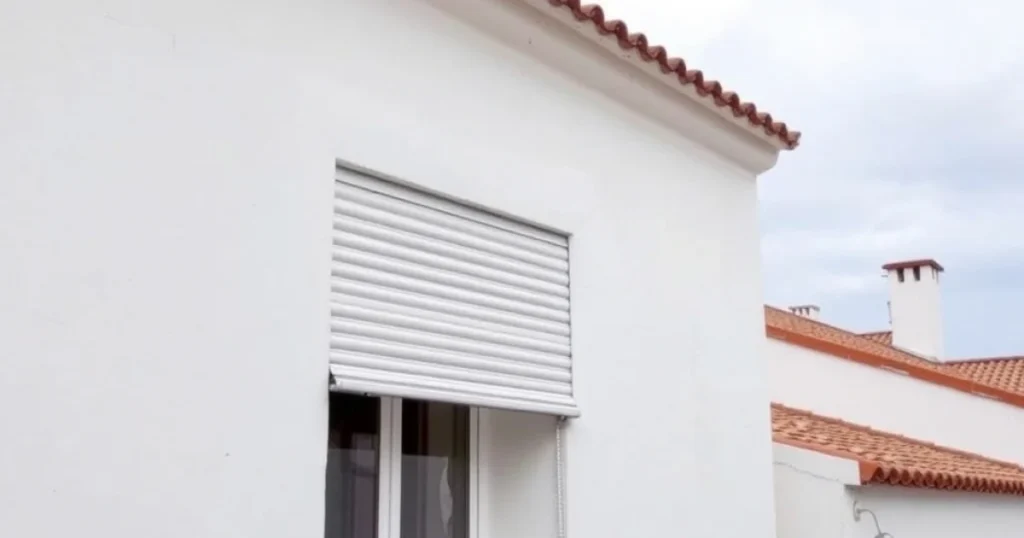
- Inside the shutter box, where a metal roller and a cold void hold moisture all winter.
- Bathrooms with no extractor and a window nobody opened for six months.
- The washing machine drum and dishwasher, both of which grow mould if closed up wet.
What to do the day you arrive
In this order, before you unpack.
- Open everything. Every window, every internal door, every wardrobe and cupboard door. Cross ventilation for a full day does more than any product.
- Pull furniture away from external walls and leave it there while the house dries.
- Photograph every affected area before touching it. You want the comparison next spring, and you want it for the insurer if it turns out to be a leak.
- Take everything out of the affected cupboards. Fabric holds spores and reinfects a cleaned surface.
- Run every tap and flush every WC, because dry traps are the other smell you are dealing with and they are ten seconds to fix.
- Do not paint anything yet. Painting over damp masonry traps moisture and the paint fails within one season.
Cleaning it properly, and what not to use
The internet’s answer is bleach. It is the wrong answer on a masonry wall.
Bleach is mostly water, and on a porous surface it whitens the mould without killing what is inside the plaster, so the colour disappears and the growth returns. It also does nothing about the moisture. On a hard non porous surface like tile or glass it is fine.
For painted plaster, use a proper fungicidal wash, follow the contact time on the label rather than wiping it straight off, and let the wall dry completely before doing anything else. Ventilate while you work and wear a mask, because disturbing mould releases spores into the room you are standing in. For fabric, soft furnishings and anything porous that is badly affected, replacement is usually more honest than treatment.
Then leave it. A wall that has been wet all winter needs days to dry, not hours, and every coating you apply before it is dry will fail.
Fixing it so it does not come back
Three things change the outcome, and only one of them is decorating.
Ventilation. The permanent fix in a closed house is air movement. Trickle vents in window frames, a vent in the shutter box, an extractor in a bathroom that has none, or simply a gap at the top of a shutter rather than a house sealed like a tin. A house that can breathe slowly all winter does not reach dew point on its walls.
Surface temperature. You cannot insulate a whole house for the sake of one bedroom, but you can stop the coldest spots being the coldest. Insulated plasterboard or an insulating render on the one north facing wall that always fails is a targeted job, and it is far cheaper than the whole envelope.
The right coating. Anti mould paint is not decoration, it is a fungicidal system, and it only works on a dry, properly prepared surface. Applied over a wall that is still damp, or over old flaking paint, it fails as fast as ordinary emulsion. Preparation is most of that job, which is why painting and decorating on a wall that has had mould is a different quote from repainting a clean room.
Where the mould is in a bathroom, on grout lines or along failed shower silicone, the fix is replacement rather than cleaning. Silicone that has gone black is colonised right through and no product recovers it. Cutting it out and resealing properly is a short job with a permanent result, and it belongs with tiling, grout and damp work rather than with painting.
Shutters, flyscreens and the sealed house problem
There is a specific trap here that catches owners who are trying to be careful.
You close the house for winter. You close every shutter to keep the sun off the furniture and to make the place look unoccupied. Perfectly sensible, and it also removes the last route air had to move. A house with every shutter down and every window closed for five months has no ventilation at all.
The compromise that works is leaving shutters partly raised on a couple of windows on different sides of the house, ideally where they are not visible from the street, with the windows on a locked vent position if they have one. If security is the concern, that is what flyscreens and window restrictors are for. Shutter mechanisms themselves also seize over a closed winter in salt air, which is the other reason to work them occasionally rather than leaving them shut, and shutter and flyscreen work is one of the most common calls we get in the first week of April for exactly that reason.
Dehumidifiers: what they can and cannot do
A dehumidifier is a good tool and a bad plan.
It works while it runs, and in an occupied house through a wet month it earns its place. In an empty house it needs power, it needs the tank emptied or a permanent drain run to a sink or outside, and it will fill and stop within days if left on a tank. A dehumidifier that stopped in November has done nothing for you since November.
If you are going to use one in a closed house, plumb the drain hose to a waste point, put it in the room that always fails, leave the internal doors of that part of the house open, and have somebody check it. Otherwise the honest answer is that ventilation costs nothing and works for five months unattended.
The autumn checklist that prevents all of this
Ten minutes in October saves the April surprise.
- Pull all furniture a few centimetres off external walls before you leave.
- Leave wardrobe and cupboard doors open, and empty them of fabric where you can.
- Leave internal doors open so air can move through the house.
- Leave two shutters partly up on different aspects, with windows in a vented or locked position.
- Leave the washing machine and dishwasher doors open, drums empty and dry.
- Empty the fridge, clean it, and leave the door propped.
- Run water into every drain and add a little cooking oil to slow evaporation in the traps.
- Take bedding and towels home or seal them, rather than leaving them in a cupboard.
- Clear gutters and check the roof line before the November storms, since a real leak in winter is a far bigger problem than condensation.
- Ask somebody to open the house for a day mid winter. One February airing changes the April result completely.
That last one is the item people skip and the one that matters most. A single visit to open the windows, run the taps and look at the walls is a small job, and it is the core of what scheduled property maintenance for absent owners actually consists of. You get photographs, and you find out about the roof tile in February rather than in April.
What it costs to sort out
Rough shape of it, so you can judge a quote.
| Job | Scale |
|---|---|
| Winter airing visit with photo report | Single short job |
| Cutting out and replacing failed shower silicone | Part of a half day |
| Fungicidal wash, preparation and anti mould repaint of one wall | Half day, plus drying time between stages |
| Fitting vents, adjusting shutters, servicing mechanisms | Half day |
| Insulated board or insulating render on one problem wall | Full day or more, depending on the room |
| Whole property spring open up and snag list | Full day |
Our indicative rates are on the prices page, and the reason we price by half day and full day rather than by the hour is exactly this kind of work: preparation, waiting for a wall to dry, and coming back to the next stage does not fit an hourly meter honestly.
When to stop cleaning and call somebody
Four situations where repainting is not the answer.
- The same wall has come back three winters running. The wall is not the problem, the conditions are, and nobody has changed them.
- The affected area is larger than about a square metre, or spread across several rooms.
- Anyone in the household has asthma or a respiratory condition. Disturbing a large area of mould is not a job to do yourself.
- You cannot tell whether it is condensation or a leak. Guessing wrong costs a great deal more than an hour of somebody looking.
We work across Tavira, Cabanas, Santa Luzia, Conceicao, Luz de Tavira and Santo Estevao, and out to Fuseta, Olhao and Vila Real de Santo Antonio. The full list is on the areas page. Spring is our busiest season for precisely this, so if you are arriving in April, message before you land rather than after.
Frequently asked questions
Why does my Algarve house get mould when the climate is so dry?
Because the buildings have little or no insulation and no heating, so wall surfaces get cold in winter while the air inside still carries moisture. Around 69% of Portuguese buildings have no effective thermal insulation, and roughly a quarter of homes report damp or leaks, among the highest rates in the EU. A mild climate is why nobody built for it.
Is the black mould on my wall dangerous?
Mould growth is associated with respiratory problems and poorer indoor air quality, and it is worth taking seriously rather than living with. Anyone with asthma or a respiratory condition should not be the person cleaning a large affected area. Ventilate, wear a mask, and for anything beyond about a square metre get help.
Will bleach get rid of it?
On tile or glass, yes. On painted plaster it whitens the surface without killing what is inside the wall, so it returns. Use a proper fungicidal wash, respect the contact time, let the wall dry fully, and then deal with the reason the surface was wet.
Should I leave a dehumidifier running while the house is empty?
Only if the drain hose is plumbed to a waste point, since a tank fills within days and then the machine has been doing nothing for months. For a house closed all winter, ventilation and furniture pulled off the walls achieve more, unattended and at no cost.
Is it condensation or rising damp?
Rising damp starts at floor level and rises to roughly a metre, with a tide mark and salt crystals. Condensation appears in corners, on ceilings, on window reveals and behind furniture, and it is worse on north facing walls. If the damp is at head height, it did not rise from the ground, and anybody selling you an injection treatment for it deserves a second opinion.