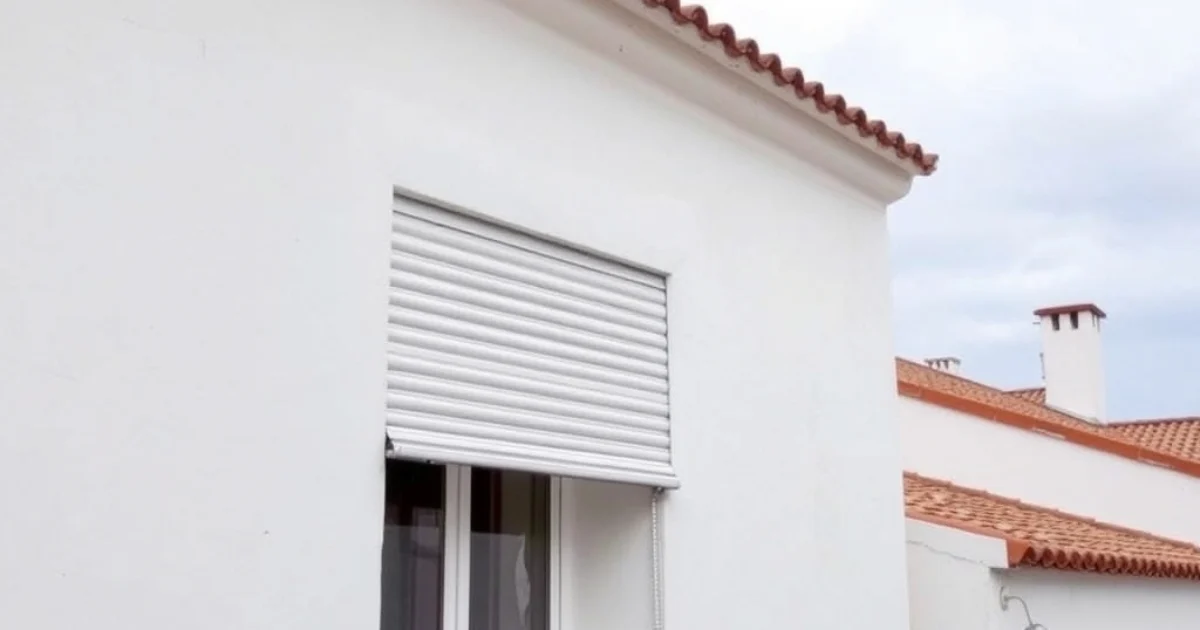
Most roller shutters that jam in Portuguese houses have one of four problems: a worn strap, a broken spring winder in the wall, slats that have left their guides, or dirt and salt in the guides themselves. Electric shutters add a fifth, the motor or its limit switches. Do not force a stuck shutter, because that bends the slats and turns a small repair into a bigger one.
Almost every house in the eastern Algarve has them, the estores that roll down from a box above the window. They do a lot of work: they keep out the summer heat, the winter wind and the light at six in the morning. Because they are always there, nobody thinks about them until one stops halfway on the first stormy night of the autumn.
How a Portuguese roller shutter works
Above the window, usually hidden behind the plaster or a panel, there is a box with an axle inside. The shutter is a curtain of horizontal slats, the réguas, in PVC or aluminium, that rolls around that axle. As it goes down, the slats run in two vertical guides, the calhas, one on each side of the window.
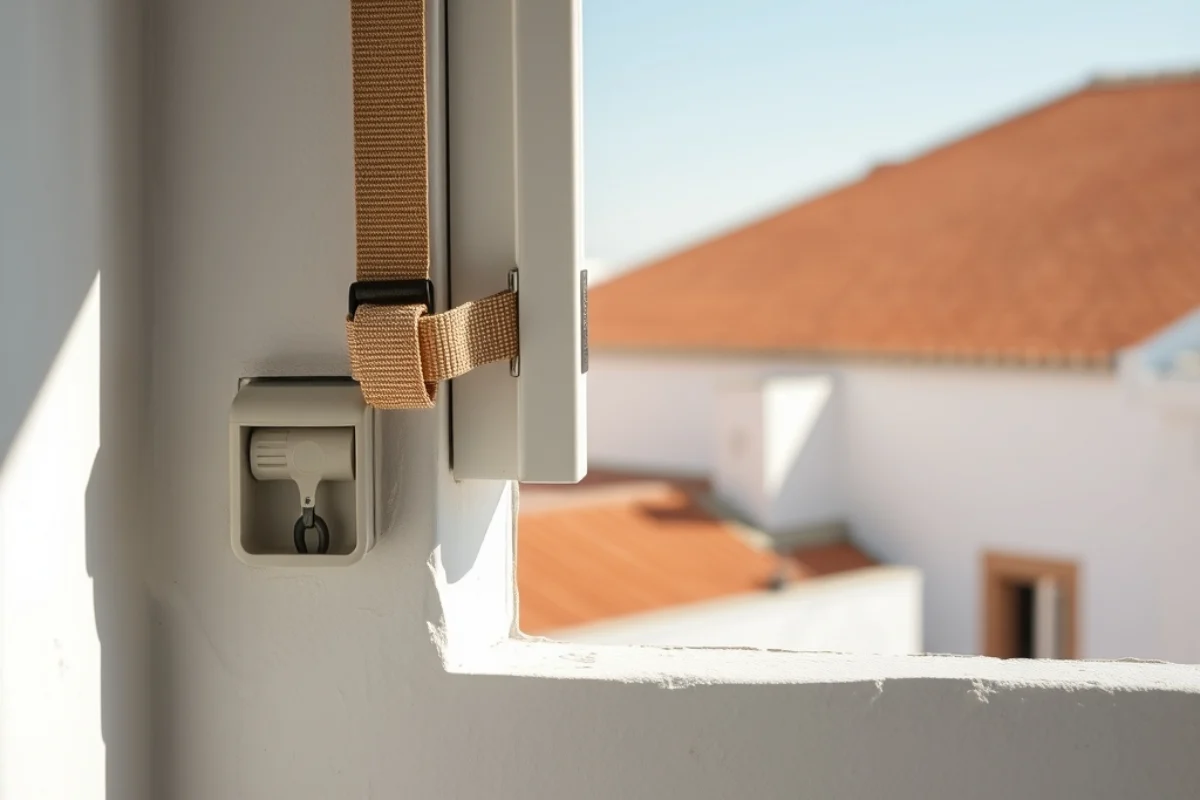
A manual shutter is moved by a strap, the fita, that comes out of the wall beside the window and winds into a spring loaded winder, the recolhedor, inside a small box in the wall. An electric shutter has a tubular motor inside the axle instead, controlled by a switch or a remote, with limit switches that tell it where to stop at the top and the bottom.
Why they jam
The symptom usually tells you where the problem is.
Why autumn makes it worse
A summer of strong sun is hard on PVC slats, which can warp slightly and start catching in the guides. The first autumn storms push the shutter against the guides with every gust, and a slat that was only just in place comes out. Near the sea, in Cabanas, Santa Luzia and around the Ria Formosa, salt air corrodes aluminium guides and fittings, and a summer of calima leaves fine dust in every channel.
Houses that stay closed make it worse again. A shutter left down for three months, with its strap wound tight in a damp wall, is the one most likely to fail the first time someone pulls it in spring.
What you can safely do yourself
A few things are fine for anyone, and they solve a good share of stiff shutters.
- Clean the guides with a brush and water, from the bottom up, and let them dry.
- Use a silicone spray on the guides, not oil or grease, which collect dust and make the problem worse.
- Look at the strap where it enters the wall. If it is fraying, have it changed before it snaps with the shutter half down.
- For an electric shutter that stops responding, check the breaker and the switch, then wait twenty minutes: most motors have a thermal cut out that stops them after repeated use.
What you should not do is force it. Pulling hard on a strap that will not move, or pushing a shutter up by hand when it is stuck, bends slats and can break the winder or the axle fixings. If it does not move with normal effort, leave it where it is.
What a repair involves
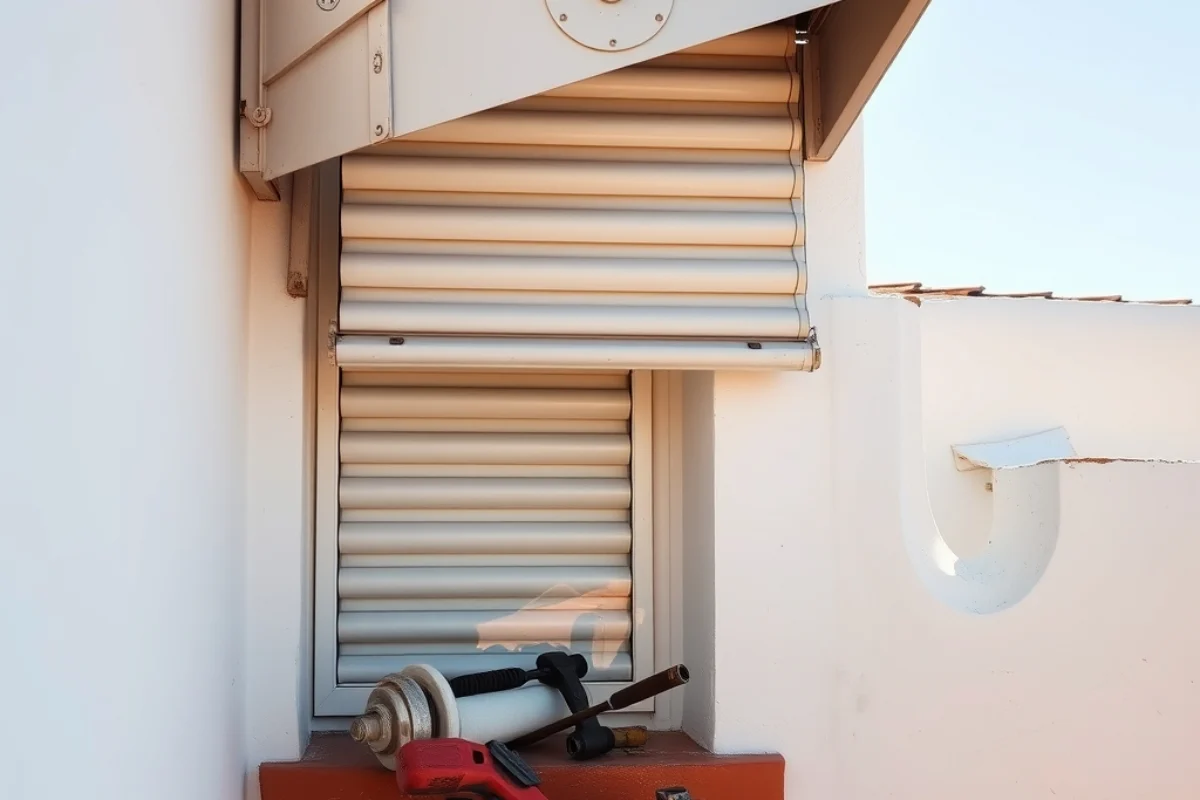
Most repairs are done from inside the house. The strap winder sits in a small box in the wall and comes out with a couple of screws. Slats and the axle are reached through the shutter box above the window, which usually has a removable panel on the inside.
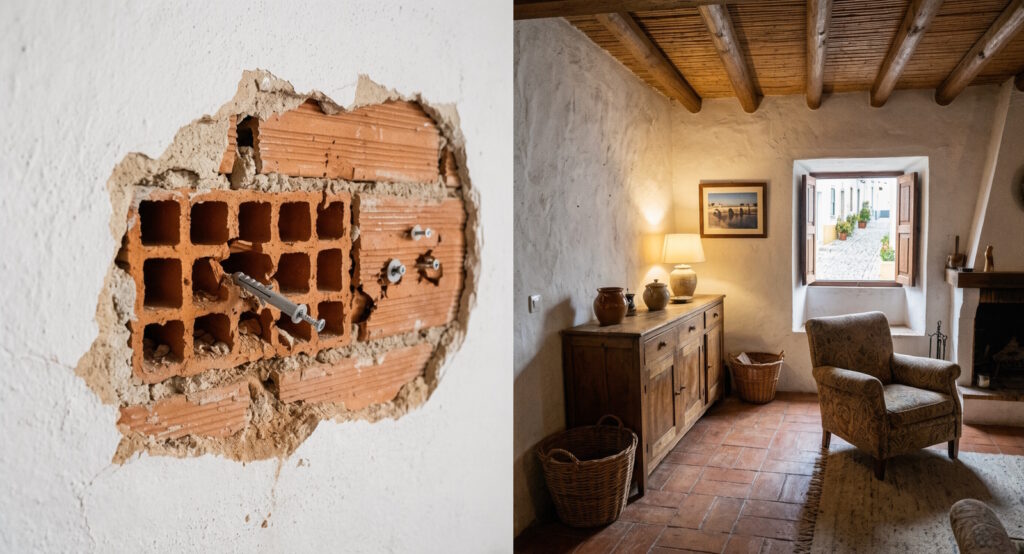
In older houses that panel is sometimes plastered over or tiled, and reaching the axle means opening it and making good afterwards. It is worth knowing that before a repair starts, because the opening is often a bigger part of the job than the repair itself. The fixings in that wall also matter: Portuguese houses are mostly built with hollow brick, and screws that are not fixed properly pull out with time, which we explained in why wall plugs keep failing in Portugal.
Manual or electric?
Converting a manual shutter to electric is a common job, and it is done by fitting a tubular motor inside the existing axle, with a wall switch or a remote. For a holiday let or a house that is often empty, it has two practical advantages: no strap to wear out, and the option of a timer, so the shutters open and close during the day and the house does not look empty from the street.
Electric shutters still fail, but differently. Motors last many years, while capacitors and limit switches are the parts that usually go, and both are repairable without changing the shutter.
What it costs in 2026
On the prices published by our handyman team in July 2026, a strap and winder repair starts at 70 euros and an electric motor replacement starts at 180 euros, with the call out within the Tavira municipality included.
These are indicative starting prices. Every shutter and every house is different, and the final price depends on the size of the shutter, the access to the box and the parts needed, so ask for a quote before the work. A photo of the shutter and the box usually gives a good first idea. You can see the work we do on our page about shutter and flyscreen repairs in Tavira.
A routine that keeps them working
Shutters last longest when they are used. Twice a year, in October before the rain and in May before the heat, run every shutter in the house all the way up and all the way down, and clean the guides while you are at it. It takes half an hour in a normal house, and it is the moment you notice the strap that is starting to fray or the slat that catches.
In a house that stays closed for the winter, ask whoever checks on it to raise and lower each shutter on every visit. A shutter that moves every two or three weeks rarely seizes, and one that has been down since October often does.

When it is not the shutter
Sometimes the shutter is only where the problem shows. Water coming in around the shutter box after rain usually means the box or the lintel above the window is letting water through, which is a builder’s job. Black mould on the inside of the box or around the window is usually condensation in a closed house, which we covered in why Algarve houses grow mould in winter.
Frequently asked questions
Why does my roller shutter strap not wind back?
The spring inside the strap winder in the wall has broken or worn out. The winder is a standard part and is replaced from inside the house, usually without touching the shutter itself.
Can I oil a stiff roller shutter?
Use a silicone spray on the guides after cleaning them. Oil and grease collect dust and sand, so they make the shutter stiffer within weeks.
My electric shutter stopped working. What should I check?
Check the breaker and the switch, then wait about twenty minutes, because most motors cut out after repeated use to protect themselves. If it still does not move, the motor, the capacitor or the limit switches need looking at.
How much does a roller shutter repair cost in Tavira?
On our published July 2026 prices, a strap and winder repair starts at 70 euros and a motor replacement at 180 euros. Every shutter is different, so ask for a quote with a photo first.
Is it worth converting manual shutters to electric?
For many houses, yes, especially holiday homes. There is no strap to wear out, and a timer can open and close the shutters while the house is empty.