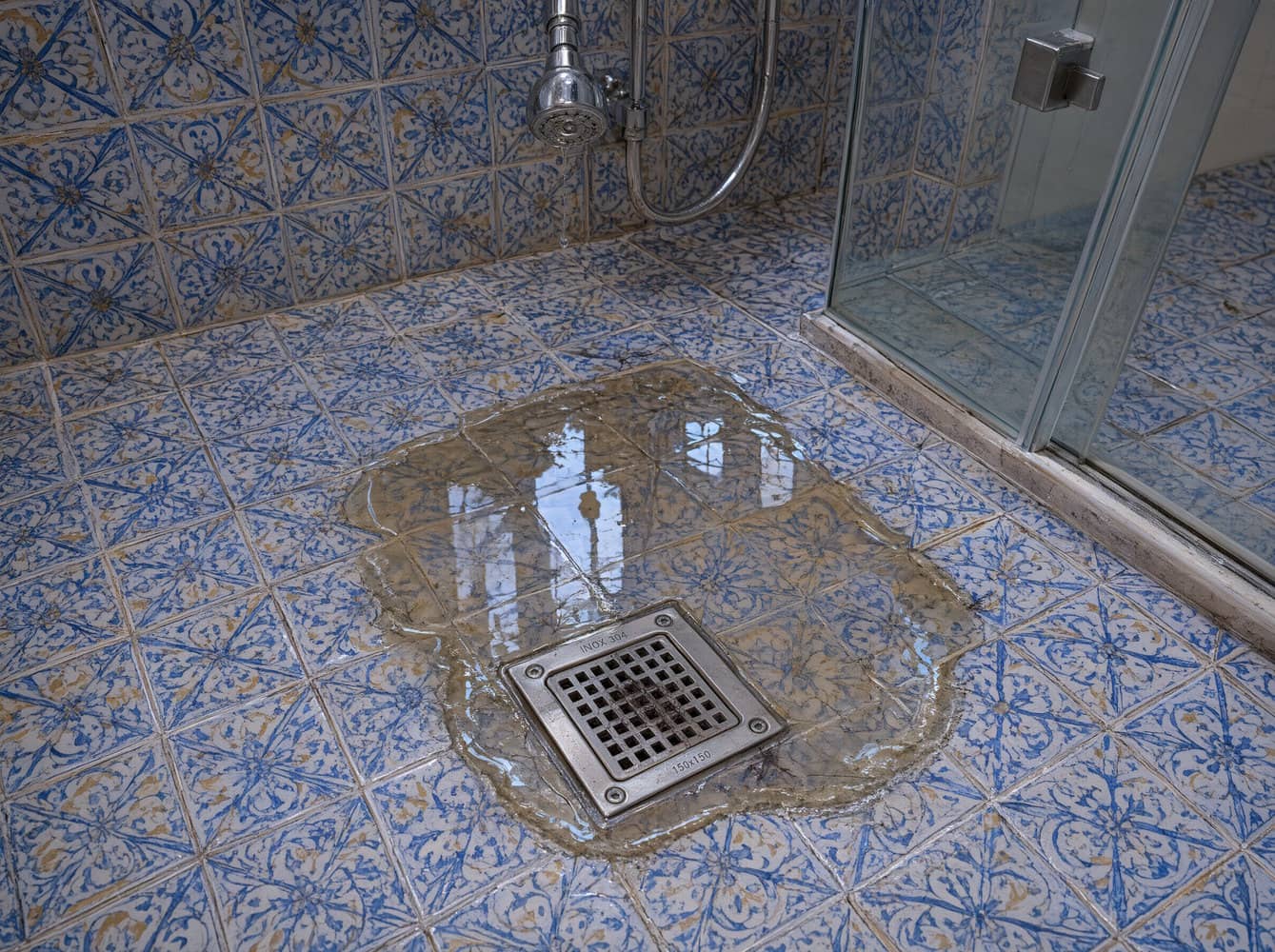
You open the door after two weeks away and the house has a smell. Not damp, not stale air. It is the unmistakable low note of drains, sitting in the hall like something that has moved in while you were gone. You check the bathroom. Nothing overflowing, nothing blocked, everything looks exactly as you left it. And yet the smell is there, strongest near the shower.
Nine times out of ten in a Tavira home, this is not a fault and it is not sewage backing up. It is a dry trap, and it fixes itself in about ninety seconds. But the tenth time is something you do not want to ignore, and the whole point of this guide is telling the two apart before you either panic or paint over it.
Where the smell actually comes from
Your drainage system is full of gas by design. Hydrogen sulphide, methane and ammonia are the ordinary by-products of waste decomposing in the sewer, and they are the reason a drain smells faintly if you put your nose right against it. That smell is meant to stay in the pipes. The entire plumbing system is built around one simple idea: keep that gas on its side of a water barrier, and keep your air on yours.
When a house suddenly smells of sewage, that barrier has failed somewhere. The skill is working out where, and there are only a handful of places it can be. Most of them you can check yourself in a few minutes, and knowing which one you are looking at tells you immediately whether it is a two minute job or a phone call.
The dry trap: the most common cause by a wide margin
Under every sink, shower, bath and floor drain there is a U-shaped bend called a trap, or P-trap. Its curve holds a small amount of standing water at all times, and that water is the barrier. Sewer gas coming back up the pipe hits the water instead of your room. Every time you run the tap or flush, the water in the trap is topped up without you ever thinking about it.
The problem is evaporation. If a fixture goes unused for a few weeks, the water in its trap slowly evaporates, and once it drops too low the seal is gone and the gas flows straight up the open pipe. In a normal climate a trap takes several weeks to dry out. In an Algarve summer, in a closed house with warm dry air, it happens faster.
This is why the smell shows up in exactly the places you would expect: the guest bathroom nobody used, the shower in the second bedroom, the floor drain in the garage or laundry, the utility sink behind the kitchen. Fixtures you use every day almost never smell, because you keep refilling their traps without realising.
If your house smells of drains after standing empty, and the smell is strongest near a fixture you have not used in weeks, it is almost certainly a dry trap. The fix is to run that fixture for a minute or two. That is the whole repair.
For a house that regularly stands empty between visits or bookings, there is a preventive trick worth knowing. After running each unused drain, pour a small amount of cooking oil or mineral oil into it. The oil floats on top of the water in the trap and dramatically slows evaporation, which buys you weeks or months rather than days. It is the single most useful thing an absent owner can do before locking up.
The two minute test that solves most cases
Before you call anybody, do this. It costs nothing and it resolves the majority of sewage smells in the region.
- Go to every sink, basin, shower, bath and floor drain in the house, including the ones you never use.
- Run each one for a full minute or two, enough to fill the bend below it.
- Flush every toilet, twice.
- Pour a bucket of water down any floor drains, since they have no tap to run.
- Open the windows and give it a few hours.
If the smell fades over the next day and does not come back, it was a dry trap and you are done. If it fades and then returns within a week, or if it never fades at all, you have one of the less common causes below, and now you know it is worth investigating properly rather than guessing.
When it is not a dry trap
If running every drain did not fix it, the barrier is failing for a mechanical reason rather than evaporation. These are the realistic possibilities, roughly in order of how often we find them.
| Cause | How it announces itself | Who fixes it |
|---|---|---|
| Failed toilet seal | Steady smell near one WC that does not respond to running water. The toilet may rock slightly, or the floor around its base feels soft | Plumber, the toilet has to come up |
| Biofilm in a drain | A sour or musty smell rather than pure sewage, strongest at a shower or basin that is used but still smells | Often DIY, a proper drain clean |
| Blocked or broken vent pipe | Gurgling from several drains when one is used, and a smell that moves around the house | Plumber, the vent runs to the roof |
| Cracked or leaking pipe | A smell that worsens over time, sometimes with damp appearing on a wall or floor | Plumber, needs locating first |
| Partial blockage in the main line | Slow drainage across the whole house plus smell, worse after heavy use | Plumber, drain clearing |
The failed toilet seal, in a bit more detail
This is the one that most often gets misdiagnosed as a mystery, because the toilet looks and works completely normally. Underneath it, where the base meets the drain, there is a seal. Over years it can dry, crack or shift, and once it fails, sewer gas escapes around the base of the toilet continuously, even though the flush works perfectly.
The tells are specific. The smell is steady rather than intermittent, it does not improve when you run water through the drains, it is concentrated right at floor level around one particular toilet, and the toilet may move very slightly when you sit or lean on it. Soft or discoloured flooring around the base is a stronger sign again, because it means water as well as gas has been escaping.
This is not a difficult repair for a plumber, but it is not a home job either, because the toilet has to be lifted, the old seal removed, the flange underneath checked, and the whole thing reseated squarely. Done wrong, it leaks. It is a good example of a job that is cheap when done promptly and expensive when the escaping water has been quietly damaging the floor for a year.
Biofilm: the smell that is not quite sewage
If the smell is more sour or musty than the rotten-egg note of true sewer gas, and it comes from a fixture you actually use, the cause is usually biofilm. This is the slimy layer of soap residue, hair, skin cells and bacteria that builds up on the inside walls of a drain, particularly in showers and basins. It is not a barrier failure at all, it is organic matter decomposing right there in the pipe.
The good news is that this is usually the one genuine DIY case among the mechanical causes. Remove and clean the drain cover and stopper, clear out the hair and gunk that has collected just below it, and clean down inside the drain as far as you can reach. A mixture of bicarbonate followed by hot water, left to sit, helps break down the film. Harsh chemical drain cleaners are best avoided as a routine measure, because on older pipework they cause more problems than they solve.
The vent pipe, and why it explains whole-house smells
Every drainage system has a vent, a pipe that runs up through the roof and lets air in and out of the system so that water flows smoothly and pressure stays balanced. When it works, you never think about it. When it blocks, with a bird’s nest, leaves, or debris, two things happen at once: drains start to gurgle because they cannot draw air, and the pressure changes can actually siphon the water out of your traps, drying them from the inside even though the fixtures are being used.
This is the cause to suspect when the smell is not tied to one fixture but seems to move around the house, and when you hear gurgling from one drain as another empties. It is a roof-level job and firmly one for a professional, both because of access and because diagnosing it correctly means ruling out the simpler causes first.
The Algarve-specific version of this problem
Everything above is general plumbing. Two things make it land differently here.
The first is the empty-house pattern. A very large share of properties around Tavira, Cabanas and Santa Luzia sit closed for weeks or months, which makes the dry trap not just the most common cause but almost the default one. If you manage a holiday let or return to a second home seasonally, the smell on opening up is so predictable that it is worth building the drain-running routine into arrival as a matter of course.
The second is septic systems. Out in the campo, many homes are not on mains drainage at all, and a sewage smell in a property with a septic tank has an extra possible cause: the tank itself, or its soakaway, may be full or failing. If running the traps does not fix it and the property is on a septic system, that is a distinct line of investigation, and we covered the whole subject separately in our guide to septic tanks in the Algarve.
What not to do
Two mistakes make this worse rather than better.
The first is masking it. Air fresheners, bleach poured down the drain, and scented blocks hide the symptom for a few hours and tell you nothing about the cause. Worse, if the cause turns out to be a leak or a failed seal, the time spent masking it is time the escaping water spends damaging your floor or wall. A sewage smell is diagnostic information, and covering it up throws that information away.
The second is reaching for strong chemical drain cleaners as a first move. On the older pipework common in Tavira town houses, repeated use of caustic cleaners can damage joints and seals, and if the real problem is a dry trap or a failed toilet seal, the chemical does nothing except sit in the system. Run water first, diagnose second, and treat chemicals as a last resort rather than a reflex.
When to call a plumber
Run the two minute test first, always. After that, call somebody if any of these is true.
- The smell survived running every drain and flushing every toilet.
- It is steady and concentrated around one toilet, especially if the toilet rocks or the floor feels soft.
- Several drains gurgle when one is used, or the smell moves around the house.
- Drainage is slow across the whole property as well as smelly.
- The house is on a septic system and running the traps changed nothing.
- Damp is appearing alongside the smell, which points to an actual leak.
We cover this across Tavira and the surrounding freguesias, and honestly a quick description on the phone often sorts it before anyone travels: if you tell us the house has been empty a fortnight and the smell is worst in the spare bathroom, we will tell you to go and run the shower before you pay for a call-out. When it is one of the mechanical causes, that is what our plumbing services exist for, and the diagnosis usually takes longer than the fix.
Frequently asked questions
Why does my bathroom smell like sewage when nothing looks wrong?
Almost always a dry trap. The U-bend under an unused shower, basin or floor drain holds water that blocks sewer gas, and when the fixture sits unused the water evaporates and the barrier is lost. Running the fixture for a minute or two refills it and the smell clears within a day. It is the first thing to try before assuming anything is broken.
How long does a trap take to dry out?
Usually several weeks, but faster in warm dry conditions, which is exactly what a closed-up house in an Algarve summer provides. This is why the smell so often greets owners returning to a second home or opening a holiday let after a gap between guests.
The smell came back after I ran the water. What now?
If it cleared and returned within a week, or never cleared, it is not a simple dry trap. The likeliest mechanical causes are a failed toilet seal, biofilm in a used drain, a blocked vent pipe, or on a rural property a septic issue. A steady smell around one toilet that does not respond to running water points at the toilet seal, which is a plumber’s job.
Is sewer gas in the house dangerous?
In the small quantities from a dry trap it is mainly unpleasant, though sewer gas can cause headaches and nausea at higher concentrations, so it is not something to live alongside indefinitely. Clear the cause rather than mask it, and ventilate the room while you do.
Can I just pour bleach down the drain to fix the smell?
It masks rather than fixes, and on older pipework repeated harsh chemicals can damage joints and seals. If the cause is a dry trap or a failed seal, bleach achieves nothing. Run water through every fixture first, work out the cause, and keep strong chemicals as a last resort.